EIFS Installation in Fort Lauderdale, FL
EIFS gives buildings energy efficiency, design flexibility, and a clean modern look — when it's installed correctly. We install and repair EIFS in Fort Lauderdale with the detail this system demands.
Licensed
4.8-Star Rated
Free Estimates
EIFS Installation and Repair Done by Specialists
EIFS installation in Fort Lauderdale brings the most energy-efficient exterior cladding system available to South Florida's residential and commercial market — combining the insulating performance of rigid foam with the design flexibility of a finished stucco-like surface. For Fort Lauderdale properties where reducing cooling loads is a priority, or where a contemporary architectural aesthetic with clean, smooth wall profiles is the design objective, EIFS delivers performance and appearance that traditional three-coat stucco systems cannot match. At Planet Construction FL, we install EIFS with water-managed system details that address the moisture management concerns that have historically been the system's primary vulnerability in South Florida's climate.
Bad EIFS Installs Trap Water and Destroy Walls
EIFS is a specialty system, and bad installs are catastrophic. Missing flashing details, improper drainage, wrong sealants at penetrations, or skipped weather barriers turn EIFS walls into moisture traps that quietly rot framing and grow mold for years before anyone notices. By the time the damage shows on the outside, the inside of the wall is usually already destroyed. Most EIFS failures aren't the system — they're the install.
EIFS Done to Manufacturer Specifications
We install and repair EIFS in Fort Lauderdale following manufacturer specs to the letter: proper drainage planes, correctly installed weather barriers, full flashing details at every penetration, and sealants matched to the system. Repairs start with finding existing moisture damage and fixing the source before we rebuild. The result is an EIFS wall that performs the way it was supposed to from day one.
What Is EIFS?
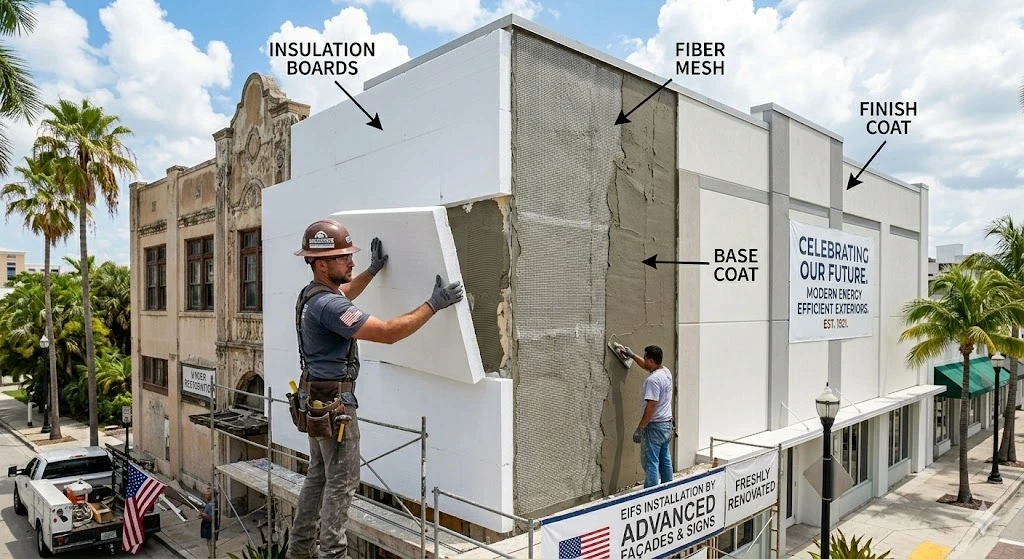
Exterior Insulation and Finish System (EIFS) is a multi-layer cladding system that consists of rigid foam insulation board adhered to the building's substrate (sheathing or masonry), followed by a reinforced polymer-modified base coat applied over the foam, and a decorative finish coat that provides the final texture and color. The result is a continuous insulation layer on the exterior of the building envelope that eliminates the thermal bridging that occurs through wall studs and framing in standard construction — providing R-values of R-4 to R-25 depending on the foam thickness specified. EIFS finish coats are available in a vast range of textures — from ultra-smooth contemporary profiles to rough-textured patterns that replicate traditional stucco finishes — and in virtually any color, making EIFS one of the most architecturally flexible exterior cladding options available.
Energy Benefits for Fort Lauderdale Buildings
The insulation performance of EIFS is particularly valuable in Fort Lauderdale's climate, where buildings run air conditioning year-round and cooling energy costs are a significant operating expense. Continuous exterior insulation reduces the rate of heat transfer through the building envelope, keeping conditioned interior spaces cooler with less mechanical cooling effort. Studies consistently show that EIFS-clad buildings in hot climates achieve 15–30% reductions in cooling energy consumption compared to otherwise identical buildings with standard stucco cladding and no continuous insulation. For commercial buildings subject to Florida's energy code requirements and LEED or sustainability certification goals, EIFS with adequate foam thickness contributes meaningfully to envelope performance compliance and energy performance documentation.
EIFS vs. Traditional Stucco — The Key Differences
Traditional three-coat stucco and EIFS produce similar visual results but differ fundamentally in construction and performance. Traditional stucco is a rigid, cementitious system applied directly to masonry or metal lath — it is vapor-permeable, which allows the wall assembly to dry appropriately in South Florida's humid climate, and it is structurally integrated with the wall. EIFS uses foam insulation as a continuous thermal break, with a polymer-modified surface that is less vapor-permeable than traditional stucco. The reduced vapor permeability of EIFS makes moisture management critical — water that enters the EIFS system through cracks, penetration failures, or deteriorated sealants has fewer escape pathways, making proper installation details at every window, door, and penetration more important in EIFS than in traditional stucco systems. Water-managed EIFS systems — which incorporate drainage channels behind the foam layer — address this concern by providing a managed path for any water that enters the system to exit at the base.
Water-Managed EIFS Systems for South Florida
Planet Construction FL installs water-managed EIFS systems — also called drainage EIFS — for all applications in Fort Lauderdale's climate. Water-managed systems incorporate a drainage mat or channels behind the foam insulation board that allow any water that bypasses the surface seals to drain down to weep screeds at the base of the wall, rather than being trapped against the sheathing. Weep screeds at the base of every wall section and at horizontal terminations provide the exit pathway. Every penetration — windows, doors, electrical outlets, light fixtures, hose bibs — is flashed and sealed with compatible sealants that are detailed to shed water away from the EIFS surface. This installation approach, combined with regular sealant maintenance at all penetrations and terminations, produces EIFS performance that avoids the moisture entrapment failures that have been documented in improperly detailed installations.
Frequently Asked Questions
Is EIFS appropriate for Fort Lauderdale's hurricane zone?
Yes — EIFS systems with Florida Building Code compliance (NOA or product approval documentation) are appropriate for Broward County's HVHZ designation. The foam insulation in EIFS systems is lightweight but provides minimal impact resistance relative to cementitious stucco, which is why proper sealant detailing and maintenance — preventing water intrusion after impact damage — is particularly important in hurricane-zone EIFS applications. Planet Construction FL installs EIFS with Florida Product Approval documentation confirming wind resistance appropriate for each project's location and building type.
How do you maintain EIFS in Fort Lauderdale?
EIFS maintenance in Fort Lauderdale primarily involves periodic inspection and resealing of all penetrations and terminations — windows, doors, and any mechanical penetrations through the EIFS surface — to prevent water entry at these vulnerable points. Annual inspection of the EIFS surface for impact damage, cracks, and sealant failures is the recommended maintenance practice. Soft washing (low-pressure washing with appropriate cleaning solutions) keeps the EIFS surface clean without the high-pressure damage that power washing can cause to the finish coat surface. Recoating with a compatible EIFS finish coat refreshes the appearance and seals minor surface cracks every 8–12 years.
Can EIFS be installed over existing stucco?
EIFS can be installed over existing traditional stucco where the existing stucco is sound, well-adhered, and provides a suitable substrate for the EIFS adhesive. Where existing stucco is delaminated or deteriorated, it must be removed before EIFS installation. The added thickness of the EIFS system — typically 1.5 to 3 inches over the existing substrate — must be accommodated at all windows, doors, and penetrations, which requires extending the flashing and sill conditions at each opening. Planet Construction FL assesses the existing substrate and all opening conditions before confirming EIFS-over-stucco feasibility for each project.
How much does EIFS installation cost in Fort Lauderdale?
EIFS installation in Fort Lauderdale typically costs 20–40% more than traditional three-coat stucco for equivalent wall area, reflecting the additional material cost of the foam insulation board and the more detailed installation requirements at all penetrations and terminations. The incremental cost above traditional stucco is partially recovered through energy savings over the building's service life. We provide a detailed line-item cost comparison between EIFS and traditional stucco alternatives for every project where both options are under consideration.