Exterior Caulking & Sealing in Fort Lauderdale, FL
Failed caulking is one of the top sources of building leaks in South Florida. We replace exterior sealants in Fort Lauderdale with products engineered for the joints they're protecting.
Licensed
4.8-Star Rated
Free Estimates
Exterior Sealant Replacement That Actually Stops Leaks
Exterior caulking and sealing in Fort Lauderdale is the most cost-effective moisture protection maintenance available — and the most consistently deferred until leaks are already happening inside. Every window frame, door frame, expansion joint, penetration, and transition on a Fort Lauderdale building's exterior is sealed against water entry with caulk or sealant. South Florida's UV radiation, thermal cycling, and hurricane wind-driven rain fail these sealants methodically over time — and when they fail, water enters. The window stain on the interior wall, the mold in the corner of the bedroom, and the concrete spall on the column below a failed joint all trace back to a sealant that was past its service life and not replaced. At Planet Construction FL, we replace exterior sealants before they fail — not after they've already let water in.
Failed Sealants Are Where Most Building Leaks Start
Caulking and sealants have a finite lifespan, and in Florida's UV and humidity, that lifespan is shorter than most people realize. Once sealant cracks, dries out, or pulls away from the substrate, water has a direct path into the building — around windows, at control joints, where stucco meets trim, and at every penetration. Most building leak investigations end at a failed sealant joint that should have been replaced years earlier.
Sealant Replacement With the Right Product for Every Joint
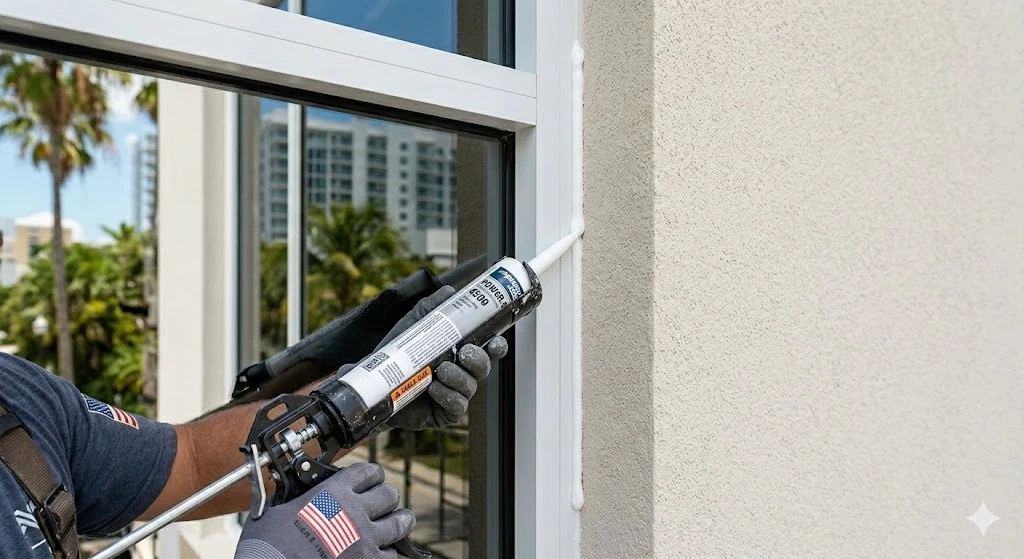
We inspect every exterior sealant joint, remove failed material completely, prep the substrate, install proper backer rod where needed, and apply high-performance sealants matched to the joint's movement and exposure. Window perimeters, control joints, expansion joints, and penetrations all get the right product for the job — and every joint is tooled properly for a long-lasting bond.
Why Exterior Caulking Matters in Fort Lauderdale
Fort Lauderdale's coastal environment is uniquely hostile to building sealants. UV radiation at South Florida's latitude breaks down the polymer binder in caulk and sealant materials faster than in northern markets, causing surface cracking and loss of flexibility within 5–8 years of installation. Thermal cycling — building surfaces reaching 160–180°F in direct summer sun and cooling rapidly during afternoon thunderstorms — subjects sealant joints to repeated expansion and contraction stress that fatigues material beyond its elongation capacity over time. Salt air from the Atlantic and Intracoastal waterways degrades sealant adhesion to aluminum, vinyl, and painted surfaces. And Fort Lauderdale's intense wind-driven rain during storm events doesn't just fall on failed sealants — it drives water horizontally into every gap with significant hydraulic force. The result is that exterior sealants in Fort Lauderdale have shorter effective service lives than identical products in less demanding climates — making proactive replacement more important, not less.
Where to Caulk on Fort Lauderdale Buildings
Every location where a building element penetrates or transitions to another is a potential water entry point that requires sealant protection. Window and door perimeter joints — the interface between the window or door frame and the surrounding wall finish — are the highest-priority sealant location on any Fort Lauderdale building. Failed window perimeter caulk is the leading cause of residential water intrusion in South Florida. Expansion joints between building sections, concrete panels, and facade elements require flexible sealant systems that accommodate the movement these joints are designed to allow. Penetrations through exterior walls — electrical conduit, hose bibs, lighting fixtures, HVAC lines, and plumbing vents — each require perimeter sealant that maintains the wall's weather barrier at the penetration location. Transitions between different cladding materials — stucco to trim board, stucco to siding, stucco to concrete — require sealant that accommodates differential movement between materials with different thermal expansion rates.
Types of Exterior Sealants We Use
Planet Construction FL selects sealant products based on the specific requirements of each joint location — joint width and depth, expected movement, surface materials, paintability, and UV exposure conditions. Polyurethane sealants are the most versatile choice for building exterior joints — they offer excellent adhesion to most substrates, high elongation, and paintability that silicone cannot provide. Modified silicone sealants combine silicone's UV stability with improved paintability for applications where both sun exposure and a painted finish are required. Pure silicone sealants are specified for joints with extreme UV exposure and no painting requirement — south-facing window perimeter joints where paintability is less important than UV resistance. For parking garage and pavement expansion joints, vehicular-grade polyurethane sealants rated for traffic loading are specified. Using the wrong sealant chemistry for a given joint location — such as a non-paintable silicone under a painted exterior — produces a failed seam that cannot be successfully resealed without complete removal of the incompatible material.
When to Replace Exterior Caulking
The most reliable indicator that exterior sealant replacement is needed is visual inspection — cracking, crazing, shrinkage from joint faces, hardening, and biological growth colonizing a porous or cracked sealant surface are all visual signs of failure. In Fort Lauderdale's climate, quality polyurethane sealants at window and door perimeters typically last 7–12 years before replacement is needed. Expansion joint sealants under vehicle traffic loading last 5–8 years. Silicone sealants on UV-exposed facades may last 15+ years. Annual visual inspection of all exterior sealant joints — ideally before hurricane season when the joints will be most tested — is the recommended maintenance practice. Planet Construction FL provides exterior sealant inspection and condition reports as part of our building maintenance programs for HOA and commercial property clients.
Frequently Asked Questions
Can new caulk be applied over old caulk?
No — applying new caulk over old, failing caulk is not an effective or durable repair. Old sealant must be fully removed to allow the new sealant to bond directly to the substrate on both joint faces. New sealant bonded to old sealant instead of to the substrate fails at the old sealant-to-substrate interface — typically sooner than the original installation did. Complete removal before reapplication is non-negotiable for a lasting exterior sealant repair.
How much does exterior caulking replacement cost?
Exterior sealant replacement is priced by linear foot of joint treated. Window perimeter sealant replacement for a typical Fort Lauderdale home — 10–20 windows — typically ranges from $800 to $2,500 depending on the number of windows, sealant type, and the condition of the existing joint. Building-wide sealant programs for commercial buildings and condominiums are priced after a full joint inventory assessment. We provide a written estimate with linear foot quantities and unit rates for every sealant replacement project.
Does exterior caulking replacement require a permit?
Standard exterior caulking and sealant replacement — maintenance-level work that doesn't alter the building structure or envelope systems — typically doesn't require a building permit. Sealant work as part of a larger structural repair or waterproofing project with a permit scope is included in the overall project permit. We confirm permit requirements for each sealant replacement project at the assessment stage.
How long does exterior caulking last after replacement?
Fresh polyurethane sealant properly installed in Fort Lauderdale's exterior joints typically lasts 7–12 years before replacement is warranted. UV-stable silicone sealants in sun-exposed locations last longer — 12–20 years in some applications. South Florida's UV intensity is the primary factor shortening sealant service life — products with higher UV stability last longer in Fort Lauderdale's direct sun environment. We specify UV-appropriate products for each joint location rather than defaulting to a single product across all exterior sealant applications.