Walkway & Pathway Repair in Fort Lauderdale, FL
Cracked, lifted, or sunken walkways are trip hazards and curb appeal killers. We repair walkways and pathways in Fort Lauderdale with techniques matched to the material.
Licensed
4.8-Star Rated
Free Estimates
Walkway Repair That Brings Properties Back to Code
Walkway and pathway repair in Fort Lauderdale addresses the outdoor circulation surfaces that residents, customers, and employees use every day — and where the trip hazards, surface damage, and ADA compliance failures that South Florida's aggressive root systems, soil movement, and climate produce create real liability for property owners. A cracked, heaved, or settled walkway isn't just unattractive — it's a slip-and-fall waiting to happen, and in Florida's active personal injury litigation environment, an unmaintained walkway with documented deterioration is a genuine legal exposure. At Planet Construction FL, we repair concrete and paver walkways throughout Fort Lauderdale — eliminating hazards, restoring surfaces, and bringing paths into ADA compliance where renovation triggers that requirement.
Damaged Walkways Are Liabilities You Can See
Lifted, cracked, or uneven walkways are more than ugly — they're trip hazards, ADA violations, and slip-and-fall lawsuits waiting to happen. Property managers, HOAs, and commercial owners face real legal exposure the moment a damaged walk is documented. And in Florida, root intrusion, soil shifts, and weather make walkway problems progress faster than most people expect.
Pathway Repair That's Safe, Compliant, and Clean
We repair walkways and pathways in Fort Lauderdale with techniques matched to the surface — concrete, paver, brick, or stone. Lifted sections get leveled, cracks get filled, failed slabs get replaced, and the underlying causes of the damage get addressed so the problem doesn't come back. Every repair brings the walkway into ADA and code compliance and is documented for your records.
Common Walkway Problems in Fort Lauderdale
Fort Lauderdale's walkway and pathway deterioration patterns are driven by specific local conditions. Tree root infiltration is the most dramatic cause of walkway damage in South Florida — Fort Lauderdale's large canopy trees (ficus, oak, mahogany, royal poinciana) produce aggressive surface root systems that lift and fracture concrete panels with extraordinary force, producing elevation changes of 2–4 inches in a single panel joint. Soil settlement beneath concrete walkway panels causes sections to sink unevenly, creating edges and abrupt transitions that meet ADA standards for trip hazards (0.5 inch maximum vertical change). Thermal cycling — concrete expanding in Fort Lauderdale's heat and contracting during cold fronts — drives cracking at panel joints and through slab centers. Chronic moisture beneath pavers from South Florida's rainfall and irrigation saturates the base material and causes paver settlement and edge failure. Each of these conditions requires a specific assessment and repair approach.
Concrete vs. Paver Walkway Repair
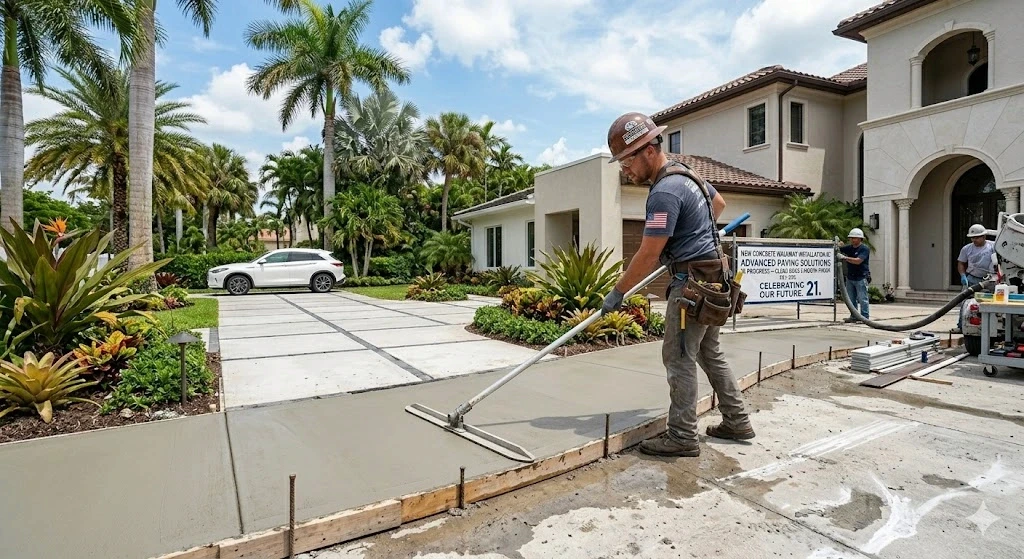
Concrete and paver walkways require different repair approaches that reflect the materials' different failure modes and repair economics. Concrete walkway repair addresses cracked or settled panels through slab lifting (raising settled panels with polyurethane foam injection to restore elevation and eliminate trip hazards), grinding (removing abrupt trip hazard edges without removing the slab), crack routing and sealing, or panel replacement where concrete is too deteriorated for surface repair. Paver walkway repair involves removing and resetting displaced pavers, correcting the base course settlement that caused the displacement, adding or replacing joint sand, and resetting edge restraints that have allowed pavers to spread beyond the intended boundary. The choice between repair and replacement for both concrete and paver walkways depends on the extent of underlying base damage — where the base course has been severely undermined, surface repair doesn't address the root cause and will produce a repeat failure within a few seasons.
ADA Compliance for Fort Lauderdale Walkways
ADA-compliant walkways and accessible routes in Fort Lauderdale commercial and multi-family properties must meet specific surface standards — maximum cross-slope of 2%, maximum running slope of 5% on accessible routes, maximum vertical change at joints of 0.5 inches, and a surface that is stable, firm, and slip-resistant. South Florida's aggressive tree roots, soil settlement, and pavement deterioration routinely push walkways out of compliance with these standards over time. Planet Construction FL's walkway repair assessments always include ADA compliance review — measuring slopes, documenting trip hazards, and confirming surface condition against the applicable standards. Walkway repairs that address safety and appearance without addressing ADA compliance create continued legal exposure for property owners whose accessible routes are technically deficient after the repair.
Our Walkway Repair Process
Walkway repair begins with a complete condition survey — documenting all trip hazards, cracked sections, settled areas, drainage problems, and ADA compliance deficiencies along the full path length. For root-related damage, we assess the root situation to determine whether root pruning and root barriers can reduce the risk of recurrence, or whether the tree's root system makes recurring damage inevitable regardless of repair method. For concrete panel repair, we specify the most appropriate repair method for each section — grinding, slab lifting, crack repair, or panel replacement — based on the specific condition. For paver walkways, base material testing confirms whether base correction is needed before resetting pavers. All trip hazards are eliminated in the repair scope, and ADA compliance is confirmed by measurement after the repair is complete.
Frequently Asked Questions
How do you stop tree roots from damaging walkways again?
Preventing root recurrence requires managing the tree's root system at the walkway edge. Root pruning — cutting the surface roots at the walkway boundary — delays recurrence but doesn't prevent it permanently; roots regrow. Root barriers — vertical HDPE panels installed along the walkway edge that redirect root growth downward and away from the walkway — provide longer-term protection. Tree removal is the only permanent solution where the tree's root system makes recurring walkway damage inevitable. We assess the root situation for each damaged walkway and recommend the approach with the best long-term outcome for the specific site conditions.
Can walkway panels be raised without replacing them?
Yes — polyurethane foam slab lifting raises settled concrete walkway panels to restore elevation and eliminate trip hazard edges without concrete removal. Foam is injected through small holes drilled through the slab, expands beneath the panel, and lifts it to the target elevation. The process is fast — most residential walkway lifting takes 1–3 hours — and the walkway is immediately ready for foot traffic after the foam cures. Slab lifting is not appropriate where the concrete slab is cracked through with differential displacement, where the concrete is significantly deteriorated, or where the base course failure is too extensive for foam to bridge. We assess each settlement situation to confirm whether lifting or replacement is the right approach.
How much does walkway repair cost in Fort Lauderdale?
Walkway repair costs vary by repair type and scope. Trip hazard grinding for a single elevated joint edge takes 30–60 minutes and typically costs $150–$350. Slab lifting for a settled residential walkway section typically costs $400–$1,500 depending on the number of panels and degree of settlement. Concrete panel replacement for a 4x4 foot section typically costs $500–$1,200 including demolition and disposal. Complete paver walkway re-base and reset projects are priced by square foot after the base condition is assessed on site.
Do walkway repairs require permits in Fort Lauderdale?
Minor walkway maintenance repairs — grinding, crack sealing, slab lifting — typically don't require permits. Concrete panel replacement, new walkway construction, and walkway modifications that change grading or drainage are subject to permit requirements that vary by jurisdiction. We identify permit requirements at the project assessment stage for every walkway repair scope.