Balcony Waterproofing in Fort Lauderdale, FL
Failed balcony waterproofing is one of the top items inspectors flag — and one of the leading causes of structural damage in Florida condos. We restore balconies with systems engineered for foot traffic, sun, and salt.
Licensed
4.8-Star Rated
Free Estimates
Balconies That Stay Sealed and Inspection-Ready
Balcony waterproofing in Fort Lauderdale is a critical maintenance obligation for every multi-story building in South Florida — because a leaking balcony doesn't just damage the balcony itself. Water infiltrating through a failed balcony waterproofing system migrates into the structural slab, accelerates rebar corrosion, damages the unit below, and creates the mold conditions that Fort Lauderdale's warm climate develops rapidly. At Planet Construction FL, we waterproof balconies comprehensively — addressing the membrane, the drains, the transitions, and the railing details that are the most common failure points in South Florida's coastal climate.
Failed Balcony Waterproofing Threatens the Whole Structure
When balcony waterproofing fails, water seeps into the slab, finds the rebar, and starts the corrosion cycle that leads to spalling, cracking, and structural damage. The damage spreads to the unit below, the surrounding concrete, and eventually the building's structural integrity. Inspectors flag failed balcony waterproofing immediately — and for good reason, because the underlying damage is almost always worse than what's visible.
Balcony Waterproofing Built to Last and Pass Inspection
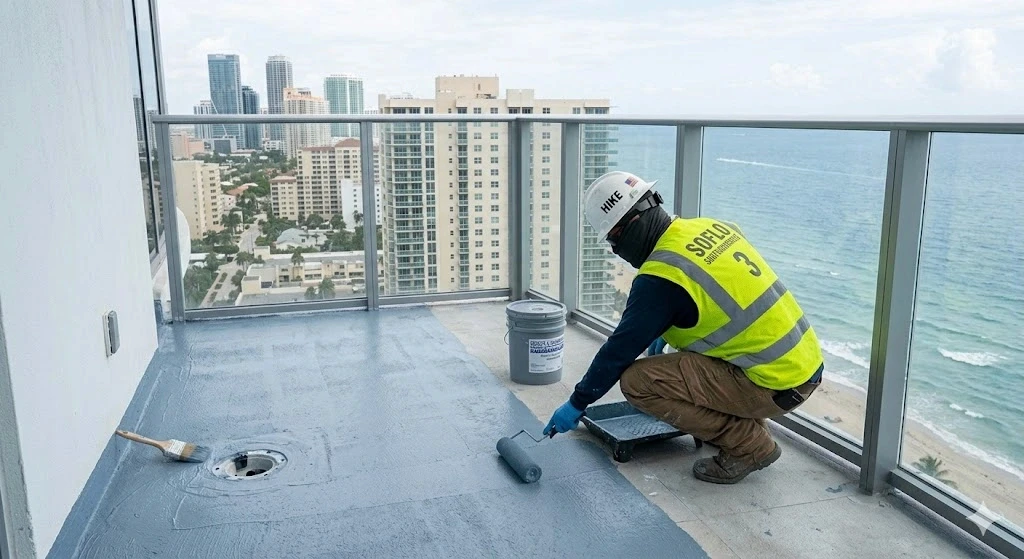
We start by repairing any underlying spalling, cracks, or structural damage — because waterproofing only works on a sound substrate. Then we install a complete waterproofing system designed for foot traffic, UV exposure, and ponding water: proper prep, primer, base coat, reinforcement, and topcoat. Every balcony is documented for your milestone or recert inspection file.
Why Balcony Waterproofing Is Critical in South Florida
Fort Lauderdale's balconies are exposed to some of the most demanding conditions of any building surface. Direct rain exposure during South Florida's intense afternoon storms delivers high volumes of water in short periods. Wind-driven rain forces water horizontally across the balcony surface and into every gap in the waterproofing assembly. Constant UV exposure degrades coatings and membranes faster than in northern climates. Salt air from the coast attacks sealants and caulking at every joint, transition, and penetration. The concrete balcony slab itself is porous — without a continuous, properly detailed waterproofing system, water moves through the slab and into the unit below. In a condominium building with dozens of balconies stacked vertically, one failed balcony waterproofing system can affect multiple units below it.
Common Balcony Leak Causes
Balcony leaks in Fort Lauderdale condominiums and residential buildings follow predictable failure patterns. Failed or missing caulking at the transition between the balcony slab and the building's exterior wall is the most common entry point — this joint moves with thermal cycling and requires a flexible, durable sealant that is renewed every 5–8 years. Deteriorated or cracked balcony waterproofing membrane at the drain collar — where the drain penetrates the slab — allows water to track beneath the membrane rather than flowing through the drain. Cracked or delaminated tile or concrete surfaces allow water ponding and slow infiltration through the slab. Railing post base failures — where corroded posts have fractured the concrete around their embedment — create open pathways directly into the slab. Each of these failure modes requires a specific repair, and addressing only one while ignoring the others produces an incomplete fix.
Balcony Waterproofing Methods
Planet Construction FL installs balcony waterproofing systems matched to each balcony's construction type and existing condition. For bare concrete balconies, a liquid-applied polyurethane membrane provides a seamless, crack-bridging waterproofing layer that is installed over properly prepared concrete and detailed at all transitions, drains, and wall-to-slab interfaces. For tile-over-concrete balconies, the existing tile is removed, the concrete substrate is prepared and repaired, a sheet or liquid membrane is installed, and new tile is set over the membrane. For balconies with an existing coating that has failed at isolated points, a targeted repair approach — addressing each failure location with compatible repair materials — can restore performance without full membrane replacement. We specify the method appropriate to each balcony's condition and budget.
Condo Balcony Waterproofing Programs
For condominium associations with multiple balconies in varying states of waterproofing health, Planet Construction FL develops systematic balcony waterproofing programs that address the full building inventory efficiently. We assess every balcony in the building, prioritize by condition and leak history, and develop a phased program that addresses the most critical units first while planning the full building scope over a multi-year capital improvement cycle. This approach allows HOA boards to budget effectively, minimizes disruption to residents, and — critically — creates a documented maintenance record that demonstrates due diligence for insurance, SB 4-D compliance, and 40-year recertification purposes. Many Broward County condominium associations now use Planet Construction FL's balcony programs as the backbone of their building maintenance planning.
Frequently Asked Questions
My balcony doesn't look damaged — could it still be leaking?
Yes — balcony waterproofing failures often aren't visible on the balcony surface itself. Water infiltrating at the drain collar or wall transition may not produce obvious surface damage but can be actively moving through the slab to the unit below. Rust staining on the soffit below the balcony, water stains inside the unit below at the ceiling, or moisture mapping with a moisture meter on the slab underside can reveal active infiltration that isn't visible from above.
How long does balcony waterproofing last?
A quality liquid-applied polyurethane membrane on a properly prepared balcony substrate lasts 15–20 years in South Florida's climate with proper maintenance. The critical maintenance items are the sealant joints at the wall transition and drain collar — these should be inspected every 3–5 years and resealed as needed. The membrane itself is typically intact long after the sealants at its edges have begun to fail.
Does balcony waterproofing require residents to vacate?
Standard balcony waterproofing work does not require residents to vacate their unit. Access to the balcony from inside the unit is needed — exterior doors should remain closed during coating application and for the cure period specified by the product manufacturer. We coordinate access timing with residents in advance of each balcony work day to minimize inconvenience.
Is balcony waterproofing covered by our building's insurance?
Gradual waterproofing deterioration is typically a maintenance exclusion under standard property insurance policies. Water damage to the unit below caused by a failed balcony waterproofing system may trigger claims under the building's policy or the unit owner's policy, depending on the association's master policy structure. We provide detailed assessment documentation that supports insurance submissions where damage has already occurred.