Exterior Wall Waterproofing in Fort Lauderdale, FL
Exterior walls take direct rain, wind-driven moisture, and constant humidity. We waterproof walls with coatings and treatments that protect both the finish and the structure underneath.
Licensed
4.8-Star Rated
Free Estimates
Walls That Stay Dry From the Outside In
Exterior wall waterproofing in Fort Lauderdale is the moisture defense layer that protects your building's structural systems, interior finishes, and occupants from the wind-driven rain, humidity, and salt air that Fort Lauderdale's coastal environment delivers continuously. Stucco, concrete, and masonry block — the dominant exterior wall materials in South Florida — are all porous to some degree, and without a proper waterproofing system applied to their surface, moisture infiltration through exterior walls is inevitable over time. At Planet Construction FL, exterior wall waterproofing is part of every building restoration project we undertake — because protecting the structure behind the surface is the reason restoration work exists.
Wall Leaks Damage More Than the Paint
Water that gets through an exterior wall doesn't just stain the inside — it saturates insulation, damages framing or block, corrodes any embedded steel, and creates conditions for mold. Most wall leaks come from cracks in stucco, failed sealants, or porous masonry that was never properly waterproofed. The damage spreads slowly, then suddenly.
Wall Waterproofing That Protects the Substrate
We assess the wall's construction, identify cracks and entry points, repair substrate damage, and apply waterproofing systems matched to the wall type — penetrating sealers for masonry, elastomeric coatings for stucco, and crystalline treatments where appropriate. Every system is applied to clean, prepped substrate at the right thickness. The result is a wall that sheds water and stays dry inside.
Why Waterproof Exterior Walls in South Florida?
Fort Lauderdale's wind-driven rain doesn't just fall downward — during tropical storms and hurricanes, it moves nearly horizontally, driven by sustained winds that force water into every crack, joint, and porous surface opening on a building's facade. Standard stucco and masonry block surfaces absorb water directly — they are permeable materials that rely on drying potential and drainage to manage moisture. In South Florida's high humidity, that drying potential is limited, meaning absorbed moisture stays in the wall assembly longer and penetrates deeper toward the interior. Over time, chronic moisture infiltration through exterior walls produces efflorescence on wall surfaces, interior water staining, mold growth in wall cavities, and the rebar corrosion that drives spalling in concrete and block construction. A proper exterior wall waterproofing system prevents all of these downstream problems at their source.
Exterior Wall Waterproofing Methods
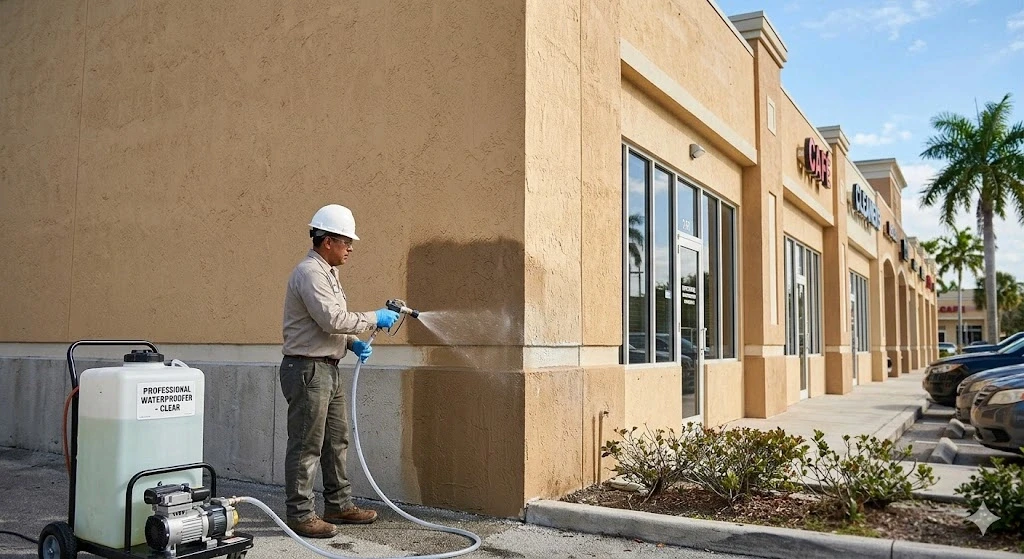
Exterior wall waterproofing product selection depends on the wall substrate material and the severity of moisture exposure. For stucco-clad walls, high-build elastomeric waterproofing coatings provide a flexible, crack-bridging, water-resistant film that dramatically reduces moisture infiltration through the stucco surface and bridges the hairline cracks that develop in stucco over time. For concrete masonry unit (CMU) block walls, penetrating silane or siloxane sealers reduce surface absorption without altering appearance, or elastomeric coatings can be applied for a greater degree of moisture resistance. For concrete walls and columns, crystalline coatings can be applied topically to reduce porosity and provide long-term moisture resistance that penetrates into the concrete matrix. At window and door perimeters and penetrations, sealant replacement is always part of any exterior wall waterproofing scope — because a perfect wall coating fails immediately at every unsealed joint or penetration.
Stucco & Masonry Waterproofing Solutions
Stucco is South Florida's most prevalent exterior finish, and stucco waterproofing is the most common exterior wall waterproofing service Planet Construction FL provides. The stucco waterproofing process begins with thorough surface preparation — pressure washing to remove biological growth and dirt, repair of cracks and delaminated areas, and re-caulking of all joints and penetrations. Elastomeric waterproofing paint is then applied in two coats to the required dry film thickness — typically 10–15 mils minimum to provide effective crack-bridging and water resistance. Masonry block waterproofing follows the same preparation and application sequence, with product selection adjusted for the block surface's different porosity and surface texture characteristics. In both cases, the result is a continuous moisture-resistant surface that protects the wall substrate from the water infiltration that drives South Florida concrete and block deterioration.
Integrating Wall Waterproofing with Window & Door Seals
Exterior wall waterproofing is only as effective as its weakest detail — and the most common weak points on South Florida building facades are the joints at window and door frames, where the wall coating terminates and the sealant begins. Wind-driven rain focuses at these transitions and will exploit any gap between the window frame and the surrounding wall finish. Planet Construction FL's exterior wall waterproofing scopes always include complete window and door perimeter sealant replacement — removing old caulk to the substrate, cleaning joint faces, and installing appropriate sealant in the correct profile and backer rod configuration. This integrated approach — wall coating plus sealant replacement — produces a complete moisture envelope rather than a patchwork that allows water entry at unaddressed transitions.
Frequently Asked Questions
Can exterior wall waterproofing stop interior water staining?
Yes — if the water staining is caused by moisture infiltrating through the wall surface or perimeter joints. Before specifying exterior waterproofing, we confirm the source of the moisture. Interior water staining can also result from roof leaks, plumbing leaks, or condensation — conditions that exterior wall waterproofing doesn't address. Our assessment confirms the moisture pathway before work begins, so the treatment actually targets the cause.
How long does exterior wall waterproofing last in Fort Lauderdale?
Quality elastomeric waterproofing coatings on stucco or masonry typically last 10–15 years in Fort Lauderdale's UV and humidity environment. Penetrating sealers on block and concrete last 7–10 years before reapplication. The critical maintenance items are the sealants at windows, doors, and penetrations — these should be inspected every 5 years and replaced before they fail completely and allow water entry around the edges of an otherwise intact wall coating.
Does exterior wall waterproofing change how the building looks?
Penetrating sealers are invisible — no appearance change. Elastomeric coatings are available in a full range of colors and sheen levels, from flat matte that closely resembles painted stucco to satin finishes with a subtle sheen. The thickness of the elastomeric coating does produce a slightly smoother surface than unpainted stucco in some texture applications. We provide color and finish samples before application so the final appearance is confirmed in advance.
Do we need HOA approval for exterior wall waterproofing?
If the waterproofing involves a color change from the building's current approved color, HOA architectural review and approval is typically required before work begins. Like-for-like color matches on the existing coating system typically don't require HOA approval. For condominium associations and HOA-managed buildings, we prepare the project documentation needed to support the architectural review process where approval is required.