Elastomeric Coating in Fort Lauderdale, FL
Elastomeric coatings flex with your building, breathe to release moisture, and resist UV and salt for years. We apply elastomeric systems that actually deliver on what the can promises.
Licensed
4.8-Star Rated
Free Estimates
Elastomeric Coatings That Move, Breathe, and Last
Elastomeric coating in Fort Lauderdale is the go-to solution for exterior building surfaces that need genuine waterproofing protection — not just paint. Where standard exterior paints crack, peel, and allow water infiltration within a few years of South Florida's UV and moisture assault, elastomeric coatings flex with the building's thermal movement, bridge hairline cracks as they form, and maintain a continuous moisture barrier over the surface life that standard paints simply cannot match. At Planet Construction FL, elastomeric coating is part of every comprehensive exterior waterproofing and restoration scope we deliver for buildings throughout Broward County.
Most Elastomeric Coatings Fail Because of Bad Prep
Elastomeric coatings work — when they're applied to a properly prepped surface, in the right thickness, with the right primer. Most failures aren't the product; they're the prep. Coatings applied over chalking, dirt, or unrepaired substrate damage peel and bubble within a year, and the warranty becomes worthless because the install didn't follow specs.
Elastomeric Application Done by the Book
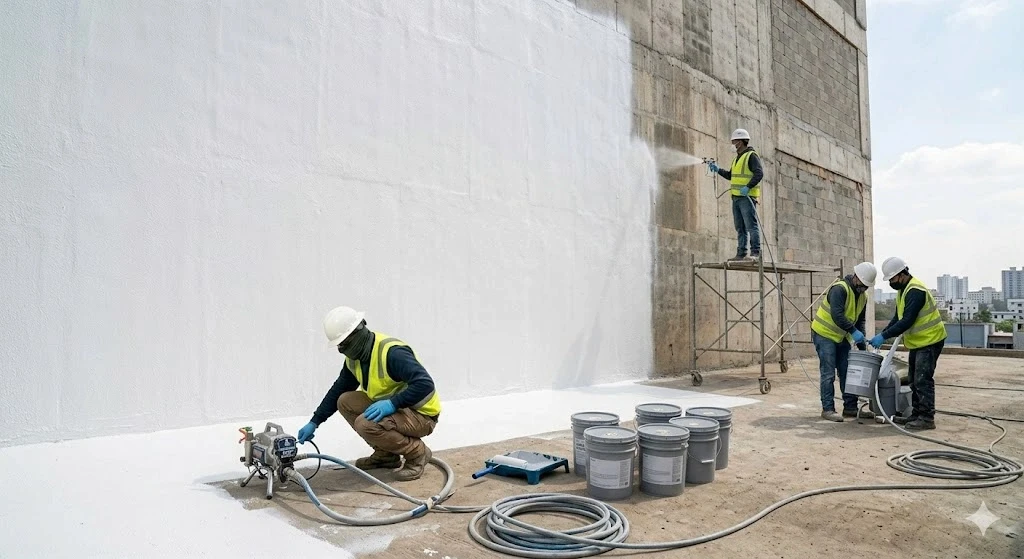
We start with serious prep: pressure washing, scraping, repairing substrate damage, and priming with the right product. Then we apply elastomeric coatings at the manufacturer-specified thickness, in the right conditions, with full documentation. The result is a coating system that flexes with the building, breathes properly, and holds up to Florida UV and salt for years — not months.
What Is Elastomeric Coating?
Elastomeric coating is a thick, high-build exterior coating formulated with a high concentration of acrylic polymers that give it elongation properties — the ability to stretch and recover without cracking. Where standard exterior paint has an elongation of perhaps 10–15%, quality elastomeric coatings achieve 100–300% elongation before failure. This means that as the building moves with thermal cycling — walls expanding in Fort Lauderdale's heat and contracting at night — the elastomeric coating moves with it rather than cracking. When hairline surface cracks develop in the stucco or concrete beneath, the elastomeric coating bridges them, maintaining a continuous moisture barrier over the crack without failing. Applied at the proper film thickness, elastomeric coatings also provide measurable water-resistance ratings that standard paints cannot achieve.
Benefits of Elastomeric Coating in South Florida
For Fort Lauderdale building owners, elastomeric coating delivers several performance advantages over standard exterior paint systems. The crack-bridging capability is the primary benefit — eliminating the hairline cracks through which South Florida's rain, salt air, and moisture enter the wall assembly and attack the concrete or block substrate beneath. The high-build film thickness reflects UV radiation more effectively than thin-film paints, reducing surface heat absorption and slowing UV degradation of the coating itself. The water-resistant film formed by a properly applied elastomeric system qualifies as a waterproofing system for above-grade walls — providing genuine moisture protection rather than just cosmetic coverage. Premium elastomeric products with titanium dioxide pigmentation also deliver meaningful cool-roof benefits on exterior walls, reducing heat transmission into the building interior.
Applications in Fort Lauderdale
Elastomeric coating is appropriate for a wide range of exterior surfaces on Fort Lauderdale's residential and commercial buildings. Stucco-clad building exteriors are the most common application — elastomeric coating over properly prepared stucco provides a waterproofing layer that standard paint cannot replicate and extends the service life of the stucco system significantly. Concrete masonry unit (CMU) block construction — common in South Florida's commercial and industrial buildings — benefits from elastomeric coating that bridges block joints and seals the inherently porous block face against moisture infiltration. Concrete surfaces on parking structures, building exteriors, and retaining walls all benefit from elastomeric coating's combination of UV stability, flexibility, and moisture resistance. Flat roofs that use elastomeric roof coatings as their primary waterproofing system are a related but distinct application with their own product specifications.
Elastomeric vs. Standard Exterior Paint
The differences between elastomeric coating and standard exterior paint are not marketing distinctions — they are measurable physical performance differences. Standard exterior acrylic paint applied to a Fort Lauderdale building exterior will typically develop surface cracking within 3–5 years as thermal cycling fatigues the paint film beyond its elongation capacity. Elastomeric coating, with its high-elongation polymer system, resists thermal cracking for significantly longer and actively bridges the micro-cracks that develop in the substrate beneath. The dry film thickness of elastomeric coating is typically 10–15 mils per coat, versus 2–3 mils for standard exterior paint — this additional thickness is what provides the crack-bridging and waterproofing performance that thin-film paints cannot achieve at any price point.
Frequently Asked Questions
How long does elastomeric coating last in Fort Lauderdale?
Quality elastomeric coating on properly prepared stucco or concrete surfaces typically lasts 10–15 years in Fort Lauderdale's UV and humidity environment before recoating is needed. The coating's UV-stable formulation resists the color fade and chalking that shortens standard paint service life, and the high-build film maintains its crack-bridging performance well into the coating's service life. Periodic washing and prompt repair of any mechanically damaged areas extend the service life toward the top of this range.
Does elastomeric coating require special surface preparation?
Yes — and this is where most coating failures begin. Elastomeric coating must be applied to a clean, sound, dry substrate free of any existing failing coating, efflorescence, oil, mold, or biological growth. All cracks and spalled areas in the substrate must be repaired before coating application — elastomeric coating bridges hairline cracks but cannot structurally repair loose or delaminated substrate. Planet Construction FL performs complete surface preparation on every elastomeric coating project as a non-negotiable prerequisite to coating application.
Can elastomeric coating stop existing water leaks?
Elastomeric coating significantly reduces water infiltration through above-grade walls, and in many cases stops infiltration at cracks and porous surfaces where it has been occurring. However, active water infiltration through joints, window frames, and penetrations requires sealant repair in addition to surface coating. Elastomeric coating is part of a complete waterproofing approach — not a standalone solution for every leak source.
Is elastomeric coating available in custom colors?
Yes — elastomeric coatings are available in a full range of custom colors, tintable through the same color matching systems used for standard exterior paint. The high titanium dioxide content of quality elastomeric products does affect the depth of achievable color in deep tones — very dark colors may show more fading over time in Fort Lauderdale's UV environment than lighter tones. We advise on color selection considering both aesthetics and long-term UV performance for each project.