Mold Prevention Waterproofing in Fort Lauderdale
Mold doesn't grow without moisture — and in Florida, moisture is everywhere. We waterproof problem areas with systems that stop the conditions mold needs to grow.
Licensed
4.8-Star Rated
Free Estimates
Stop the Moisture, Stop the Mold
Mold prevention waterproofing in Fort Lauderdale attacks mold at its actual cause — uncontrolled moisture — rather than treating the mold symptoms that appear on surfaces after the moisture problem has already done its work. South Florida's warm temperatures (typically 70–90°F year-round) and high humidity create ideal mold growth conditions the moment moisture enters a building envelope. Fort Lauderdale property owners who address mold surface growth without fixing the underlying moisture source will see mold return, reliably, within months. At Planet Construction FL, we identify and eliminate the moisture pathways that feed mold in South Florida buildings — through waterproofing, drainage, and building envelope repair that addresses the problem permanently.
Mold Is a Symptom of a Moisture Problem
Mold growth in walls, ceilings, and crawl spaces is almost always a symptom of an unresolved moisture issue — a leak, condensation, or chronic humidity that gives mold the conditions it needs to thrive. Cleaning the visible mold without solving the moisture source guarantees it comes back, and the underlying damage to materials keeps spreading the whole time.
Waterproofing That Removes the Conditions Mold Needs
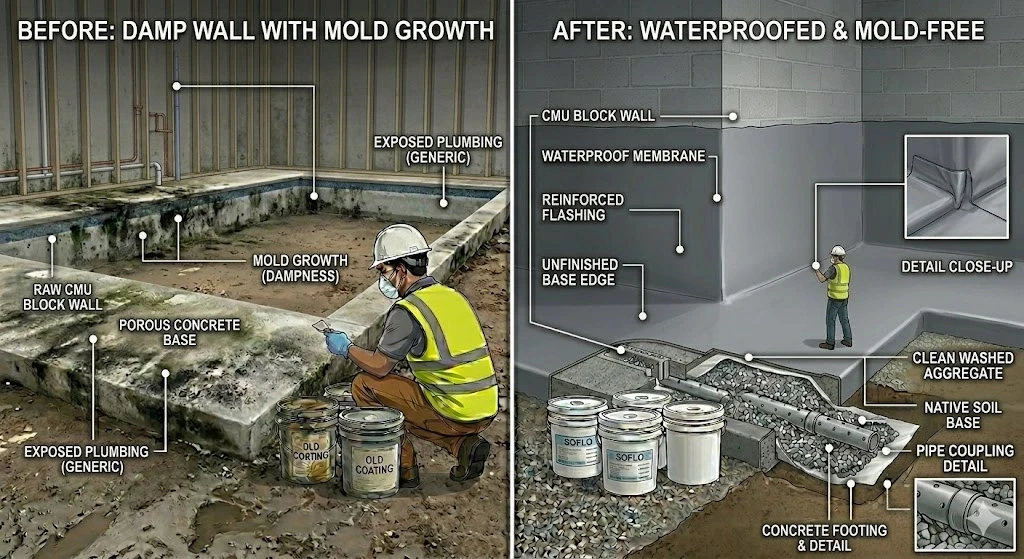
We diagnose the actual moisture source — leaks, vapor intrusion, drainage failures, or humidity — and waterproof at the source, not just where the mold appeared. That might mean exterior wall waterproofing, crawl space encapsulation, drainage correction, or sealant replacement. The result is an environment where mold doesn't have what it needs to grow.
The Link Between Moisture & Mold in South Florida
Mold requires three things to grow: organic food source (building materials provide this), suitable temperature (South Florida's year-round warmth provides this), and moisture. Remove the moisture, and mold cannot grow regardless of the temperature and available food. This is the principle behind mold prevention waterproofing — and it is fundamentally different from mold remediation, which removes existing mold but does nothing about the moisture that will grow more mold in its place. In Fort Lauderdale's climate, moisture enters buildings through failed roofing systems, failed balcony and deck waterproofing, failed window and door sealants, inadequate below-grade waterproofing, and condensation from the temperature differential between South Florida's outdoor humidity and air-conditioned interiors. Each entry point requires a specific waterproofing solution.
High-Risk Areas for Mold in Fort Lauderdale Buildings
Certain areas of Fort Lauderdale buildings carry disproportionate mold risk due to their inherent moisture exposure. Balcony-facing interior walls in condominiums — particularly on east and southeast-facing exposures that receive prevailing wind-driven rain — are chronically damp in buildings with failed balcony or window sealant systems. Below-grade and ground-floor areas in buildings near the Intracoastal, canals, or coastal flood zones experience elevated groundwater moisture that drives mold in wall cavities and flooring assemblies. Bathrooms and shower areas where waterproofing membranes have failed allow moisture into wall cavities that produce mold behind tile within months in South Florida's warmth. Roof-adjacent areas where flat roof drainage is inadequate and chronic ponding saturates the roof assembly deliver moisture to the floor and ceiling below. Planet Construction FL's moisture assessments identify and map all high-risk areas before specifying the waterproofing approach.
Our Waterproofing Approach to Mold Prevention
Mold prevention waterproofing at Planet Construction FL begins with a moisture source investigation — systematically identifying every pathway by which water is entering the building and reaching the mold-affected areas. We use moisture meters, thermal imaging, and targeted water testing to confirm each entry point rather than assuming its location. The confirmed entry points are then addressed with the appropriate waterproofing system — roof membrane repair or coating, balcony membrane replacement, window and door sealant replacement, exterior wall elastomeric coating, below-grade crystalline waterproofing, or interior French drain and sump systems — depending on the specific source. After waterproofing is complete, the building's construction should dry out over several weeks as existing moisture dissipates, and mold remediation of affected finishes can then be undertaken with confidence that the moisture source driving regrowth has been eliminated.
Working with Mold Remediation Contractors
Planet Construction FL provides the waterproofing expertise that creates the moisture-free environment mold remediation requires to be permanent. We work alongside licensed mold remediation contractors — who handle the actual mold assessment, containment, removal, and post-remediation verification — as part of a coordinated response to mold problems in Fort Lauderdale buildings. The typical sequence: Planet Construction FL completes all moisture source elimination and waterproofing work first; the building is allowed to dry to acceptable moisture levels; mold remediation is then performed by the licensed remediator with confidence that the moisture source will not immediately regenerate mold growth in the remediated areas. This sequencing is the standard of care for mold problems in South Florida — waterproofing first, remediation second.
Frequently Asked Questions
Can I skip remediation and just fix the leak?
If the mold growth is minor and confined to non-porous surfaces — tile, glass, metal — cleaning with appropriate mold-killing products after fixing the moisture source may be adequate. If the mold has colonized porous building materials — drywall, insulation, wood framing, or concrete block — professional remediation is required to remove the affected materials and verify clearance. South Florida's mold health risks are significant, and concealing rather than removing mold-colonized materials in an occupied building is not an acceptable approach from either a health or liability standpoint.
How quickly does mold grow after a water intrusion event in Fort Lauderdale?
In Fort Lauderdale's warmth, mold can begin colonizing damp building materials within 24–48 hours of a water event. After a significant water intrusion — pipe burst, roof leak during a storm, or flooding — the timeline for beginning drying and remediation is extremely short. Planet Construction FL responds quickly to emergency moisture intrusion situations to assess and begin waterproofing repair, while advising on immediate drying measures that reduce the risk of mold initiation in the interim.
Is mold in my Fort Lauderdale condo the building's responsibility or mine?
Responsibility depends on the source of the moisture. If mold in a unit results from the building's failed roof, balcony, or exterior waterproofing — elements that are typically common elements under the condo association's master policy — the association is generally responsible. If mold results from the unit owner's failed shower waterproofing or plumbing, the owner is typically responsible. The moisture source investigation is critical to establishing responsibility accurately before repairs and remediation begin.
Do air conditioning systems contribute to mold in South Florida?
Yes — condensation on cold air conditioning supply ducts and equipment in South Florida's humid environment is a significant moisture source in many buildings. Condensation forming on under-insulated cold surfaces drips onto building finishes and creates chronic moisture conditions that support mold growth independent of any building envelope leak. Proper insulation of cold HVAC components, regular drain pan maintenance, and adequate air circulation reduce condensation-driven mold risk. Planet Construction FL's moisture assessments identify condensation as a moisture source where present and recommend HVAC or insulation corrections in addition to building envelope waterproofing.