Carbon Fiber Structural Reinforcement in Fort Lauderdale
When demolition isn't an option, carbon fiber gives existing concrete the strength of new construction. We engineer and install CFRP systems that add capacity without adding weight.
Licensed
4.8-Star Rated
Free Estimates
Modern Reinforcement Without the Demolition
Carbon fiber structural reinforcement in Fort Lauderdale delivers a powerful answer to a question more and more South Florida building owners are asking: how do you strengthen an existing concrete structure without tearing it apart? Carbon fiber reinforced polymer — CFRP — is the modern structural engineering solution for upgrading load capacity, correcting past overloads, and addressing Florida Building Code deficiencies in columns, beams, slabs, and walls. At Planet Construction FL, we install CFRP systems specified by licensed structural engineers to deliver measurable, code-compliant structural improvement with minimal disruption to your building and its occupants.
Adding Capacity Usually Means Adding Concrete
When a structural element needs more capacity, the traditional solution is jacketing it with more concrete and steel — which adds weight, takes weeks, and disrupts everything around it. For many condos, garages, and retrofits, that's not practical or even possible. Without an alternative, owners face either oversized repairs or a building that can't safely meet new loads.
Engineered CFRP Systems Installed by Trained Crews
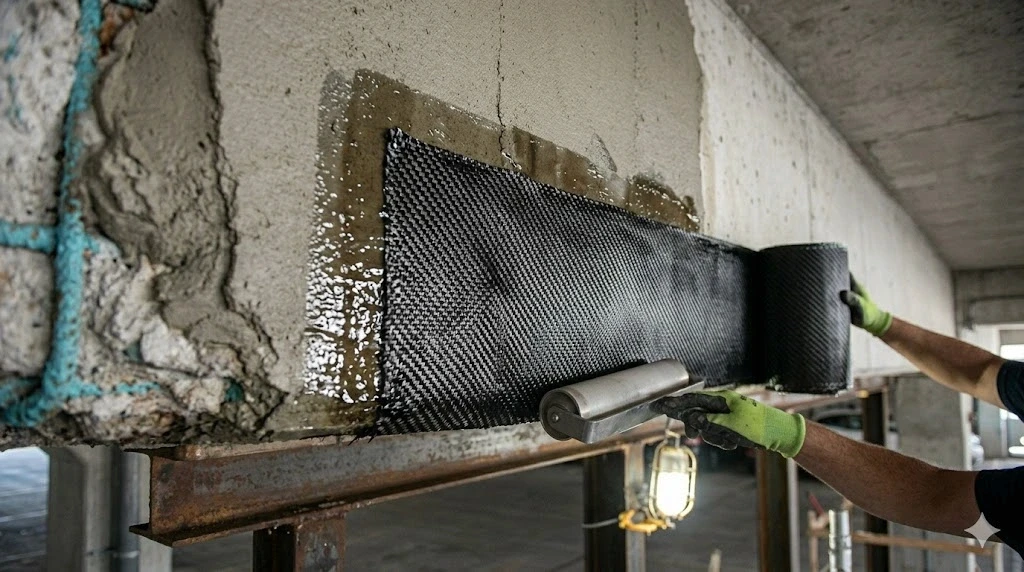
We work from engineered CFRP designs, prepping the substrate properly, installing carbon fiber sheets or strips with the right adhesives, and curing the system to manufacturer specs. CFRP adds significant tensile strength without adding weight or thickness — making it ideal for slabs, beams, columns, and walls that need more capacity in tight conditions. The result is engineered performance with minimal disruption.
What Is Carbon Fiber Structural Reinforcement?
Carbon fiber reinforced polymer (CFRP) is a composite material made of woven carbon fiber fabric impregnated with structural epoxy resin. When bonded to concrete structural elements, cured CFRP creates a tensile reinforcement layer with a strength-to-weight ratio far exceeding steel — and without steel's susceptibility to corrosion. In structural applications, CFRP is used in two primary forms: wet-layup fabric systems applied to curved surfaces and irregular geometries, and pre-cured laminate strips bonded to flat surfaces like beam soffits and slab undersides. Both systems are applied with structural epoxy adhesive and cure to a hard, dimensionally stable reinforcement that becomes monolithic with the concrete element it strengthens.
When CFRP Is the Right Solution
Carbon fiber reinforcement is the right choice in several specific structural scenarios common in Fort Lauderdale buildings. Beams or slabs that have experienced section loss from rebar corrosion and require capacity restoration beyond what mortar repair alone provides. Columns that need shear or confinement strengthening to meet current wind code requirements or address significant rebar loss. Structural walls with insufficient shear capacity for current code loads. Buildings undergoing occupancy or use changes that increase floor loads beyond the original design. And post-tensioned slabs with failed tendons where restoring partial capacity is more practical than full tendon replacement. In each case, CFRP delivers meaningful capacity enhancement with minimal disruption to occupants and operations.
Advantages Over Traditional Strengthening Methods
Traditional structural strengthening methods — adding steel plates, increasing member size, adding new beams or columns — require significant demolition, disruption, and in occupied buildings, often displacement of tenants or residents. CFRP installation is non-invasive by comparison. The laminates or fabric are thin — typically 1/16 to 1/8 inch — and add no meaningful weight to the structure. Installation requires no heavy equipment, no structural penetrations, and no disruption to the floors or spaces above and below the work area. In occupied commercial and residential buildings, CFRP strengthening can be completed with minimal impact on normal building operations — a significant advantage that conventional strengthening cannot match.
CFRP Applications in Fort Lauderdale Buildings
Planet Construction FL installs CFRP reinforcement in a range of applications common in South Florida's building stock. Column wrapping for confinement and shear strengthening in parking garage and building columns. Beam soffit laminate installation for flexural capacity upgrade and rebar corrosion section loss compensation. Slab underside strengthening for two-way flat plate systems with punching shear concerns. Wall in-plane shear strengthening with diagonal CFRP layouts. Foundation wall strengthening for bowing walls. In every case, the CFRP design is produced by the structural engineer of record, and Planet Construction FL executes the installation to that specification — including surface preparation, adhesive application, laminate positioning, and final bond verification testing.
Frequently Asked Questions
How strong is carbon fiber reinforcement compared to steel?
Carbon fiber has a tensile strength of approximately 500,000 to 700,000 psi — roughly 10 times the tensile strength of structural steel. Its stiffness is similar to or greater than steel depending on fiber grade. It weighs about one-fifth as much as steel. These properties make it extraordinarily efficient as a structural reinforcement — small cross-sections of CFRP provide large capacity contributions relative to their size and weight.
Is carbon fiber reinforcement permanent?
Yes — properly installed CFRP bonded with structural epoxy is designed as a permanent structural enhancement. The material is non-corrosive, dimensionally stable under normal service conditions, and does not creep or relax under sustained load. The bond between the CFRP and the concrete substrate is the critical interface — which is why surface preparation quality is closely controlled and inspected on every installation.
Does CFRP installation require a permit?
Yes. CFRP structural strengthening is a permitted structural repair in Fort Lauderdale and Broward County. The installation is designed by a licensed structural engineer who provides the engineering drawings and calculations for permit submission. Planet Construction FL coordinates the permitting process and schedules building department inspections as required by the permit conditions.
Can carbon fiber reinforcement be applied to any concrete element?
CFRP can be applied to most concrete structural elements provided the substrate is sound and properly prepared. Elements with significant delamination, active moisture, or heavily contaminated surfaces require substrate repair and preparation before CFRP installation. Our assessment confirms substrate suitability before any CFRP installation is scoped or proposed — we never install over a compromised substrate.