Epoxy Injection Crack Repair in Fort Lauderdale, FL
Structural cracks need more than caulk — they need pressure-injected epoxy that bonds concrete back together. We restore load capacity, not just appearance.
Licensed
4.8-Star Rated
Free Estimates
Structural Crack Repair That Restores Load Capacity
Epoxy injection crack repair in Fort Lauderdale is the precision solution for restoring structural integrity to cracked concrete beams, slabs, walls, and columns — without extensive demolition or disruption. When concrete cracks, the two faces of the crack can still be monolithically bonded through the epoxy injection process, restoring the member to its original load-carrying capacity. At Planet Construction FL, our technicians use low-pressure epoxy injection systems that fill cracks completely — from the surface to the deepest point of penetration — producing a bond stronger than the original concrete.
Structural Cracks Won't Heal Themselves
Structural cracks aren't surface flaws — they're load-path failures. A crack that goes through a beam, slab, or wall has reduced that element's capacity, and surface caulk does nothing to restore it. Worse, open cracks let water and chlorides reach the rebar, accelerating corrosion and widening the crack with every wet season. The longer it stays open, the more expensive the real fix becomes.
Pressure-Injected Repairs That Restore the Load Path
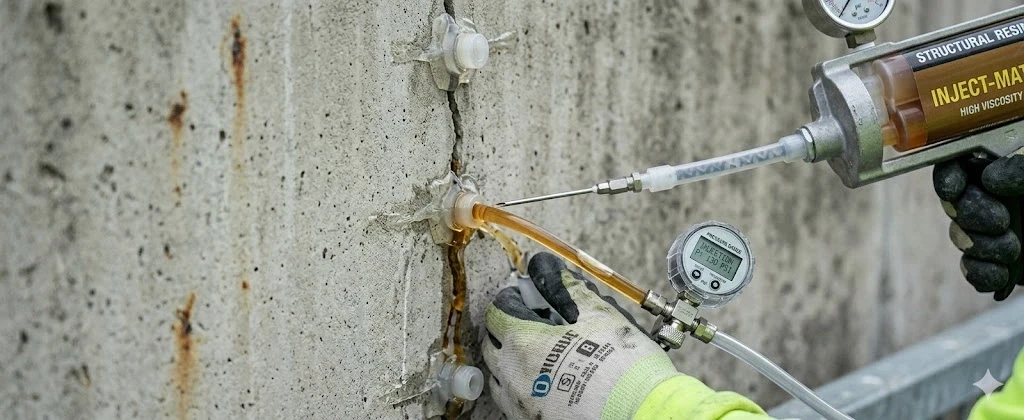
We map every crack, install injection ports along its length, and pressure-inject structural epoxy that penetrates the full depth of the crack. As the epoxy cures, it bonds the concrete back together at near-original strength and seals the crack against future water intrusion. We document the repair with photos and product data so you have proof of method and material.
What Is Epoxy Injection and How It Works
Epoxy injection is a structural repair technique that bonds cracked concrete by filling the crack void with a two-component epoxy resin system. Entry ports are drilled along the crack at calculated intervals — typically one crack-width apart — and low-pressure injection ports are installed. The two epoxy components are combined and injected under controlled pressure, starting from the lowest port and progressing upward as each port accepts material and fills the crack to the next port above. The fully cured epoxy bond achieves tensile strength exceeding the concrete itself, restoring the cracked section to structural continuity. The process is minimally invasive and leaves no visible profile change on the concrete surface.
When Epoxy Injection Is the Right Solution
Epoxy injection is appropriate for structural concrete cracks where the two crack faces are stable — not actively growing or moving. Ideal applications include cracks in load-bearing beams and slabs where structural continuity has been lost, cracks in foundation walls with no active hydrostatic pressure, and diagonal cracks in columns resulting from past overload or seismic events. It is not appropriate for actively growing cracks caused by ongoing settlement or loading changes, or for cracks with live water flowing through them — polyurethane injection is the solution for wet, active cracks. Our assessment determines which injection system is right for each crack type before any work begins.
Epoxy vs. Polyurethane Injection — Choosing the Right System
Epoxy injection bonds crack faces rigidly — the cured material is hard, strong, and non-flexible. This makes it the right choice for structural cracks in stable concrete where restoring load transfer is the objective. Polyurethane injection foams and expands on contact with moisture, making it ideal for wet cracks, active water leaks through concrete, and situations where some flexibility in the repaired zone is acceptable. Using the wrong material for a given crack type wastes money and fails to solve the problem. Planet Construction FL accurately diagnoses each crack's characteristics — width, depth, activity, moisture condition — and specifies the correct injection system for each situation.
Structural vs. Non-Structural Cracks — A Critical Distinction
Not every crack in concrete is a structural concern, but every crack is a potential water infiltration pathway in South Florida's environment. Hairline surface cracks (under 0.010 inches wide) in concrete slabs are often the result of normal shrinkage during curing and may not require structural repair, though they benefit from sealing. Cracks wider than 0.010 inches in structural members — beams, slabs, load-bearing walls — should be evaluated by a professional to determine whether structural repair is required. Diagonal cracks at 45-degree angles in beams or columns, through-cracks in walls, and cracks accompanied by deflection or movement are all indications that structural epoxy injection and engineering review are needed immediately.
Our Epoxy Injection Process
Our process starts with crack mapping — documenting width, length, depth, and orientation of all cracks in the repair scope. The crack surface is cleaned of debris, dust, and contamination that would prevent proper epoxy adhesion. Entry ports are drilled at calculated intervals along the crack. Ports are epoxy-bonded to the concrete surface and allowed to cure. The crack face between ports is surface-sealed with epoxy paste to contain the injection material. Epoxy is mixed, loaded into the injection equipment, and injected under low controlled pressure, progressing sequentially up the crack. After full cure, ports are removed, flush-filled, and the surface is finished. A load test or pull-off test may be performed on representative samples to verify bond strength where engineering documentation is required.
Frequently Asked Questions
Is epoxy injection as strong as the original concrete?
Yes — and in most cases stronger. Properly injected and cured structural epoxy achieves tensile strength of 4,000 to 6,000 psi, which typically exceeds the tensile capacity of the concrete surrounding the crack. The bond is monolithic — the crack effectively disappears as a structural discontinuity once epoxy has fully cured.
How long does epoxy injection take?
Port installation and injection for a typical crack — 3 to 10 linear feet — takes 1–3 hours of active work time. Epoxy cure time is typically 24–48 hours before the repaired member can return to service load. Larger projects with multiple cracks are staged over multiple days as needed.
Can epoxy injection stop water leaks?
For dry or dormant cracks, yes — epoxy injection creates a watertight bond. For cracks with active water flow, polyurethane injection is more appropriate because it foams and expands in the presence of moisture, effectively plugging the water pathway. We specify the correct system based on each crack's moisture condition.
Do cracks come back after epoxy injection?
If the underlying cause of the crack has been resolved — overloading addressed, settlement stabilized, rebar corrosion treated — epoxy injection provides a permanent repair. If the cause is ongoing (active settlement, live overload, growing corrosion), new cracks will eventually form. Our assessment always includes investigation of crack causes, not just the cracks themselves.