Rebar Corrosion Repair in Fort Lauderdale, FL
Rust expands steel up to seven times its original volume — that's what cracks your concrete. We remove corroded rebar, treat what's salvageable, and rebuild it right.
Licensed
4.8-Star Rated
Free Estimates
Stop the Rust That's Cracking Your Concrete
Rebar corrosion repair in Fort Lauderdale gets to the root cause of almost every concrete deterioration problem in South Florida — because rebar corrosion is what drives spalling, cracking, and structural capacity loss in concrete buildings across the region. Fort Lauderdale's salt air, high humidity, and coastal rainfall create one of the most corrosive environments for embedded steel reinforcement on the continent. At Planet Construction FL, rebar corrosion isn't an afterthought in our repair process — it is the core focus. We treat the steel, rebuild the concrete, and protect the surface to break the corrosion cycle permanently.
Rust Is Quietly Cracking Your Building Apart
Rust expands corroding steel up to seven times its original volume, and that expansion is the actual force cracking your concrete from the inside. Once the corrosion cycle starts, it accelerates — every crack lets in more moisture, every bit of moisture creates more rust, and every bit of rust creates more cracks. Surface repairs that ignore the rebar are guaranteed to fail.
Stop the Rust Cycle Permanently
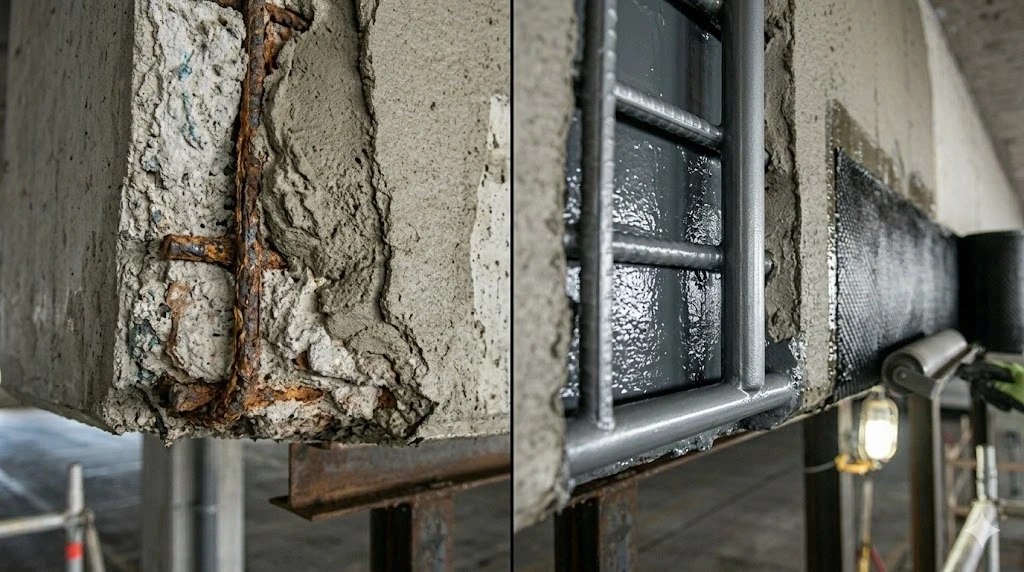
We chip back to sound concrete, fully expose the corroded rebar, mechanically clean it to bright steel, apply corrosion inhibitors, and rebuild the section with materials engineered for long-term protection. Where rebar is too far gone, we replace it. The repair stops the active corrosion — and the protective system we apply on top keeps it from coming back.
Why Rebar Corrodes in South Florida
Embedded steel rebar relies on concrete's high alkalinity to remain in a passive, non-corroding state. South Florida's coastal environment attacks this protection on two fronts simultaneously. Chloride ions from salt air penetrate the concrete matrix and break down the passive layer on the rebar surface, initiating active corrosion. Carbon dioxide from the atmosphere reduces concrete alkalinity through carbonation, further weakening the protection concrete provides to embedded steel. Once corrosion begins, the oxidation products (rust) expand to approximately four times the original steel volume — fracturing the concrete cover from within. In Fort Lauderdale's heat and humidity, this process accelerates dramatically compared to inland or northern climates.
Signs of Rebar Corrosion in Concrete
Rebar corrosion signals itself through a progression of visible indicators. Rust staining — brown or orange streaks running vertically down columns, walls, or slab soffits — is the earliest surface sign that corrosion products are migrating through the concrete to the surface. Map cracking along rebar lines, following the grid of the underlying reinforcement, indicates internal expansion pressure is building. Spalling — chunks of concrete separating from the surface — means corrosion has advanced to the point where expansion pressure has overcome the concrete's tensile capacity. Exposed rebar with visible rust or pitting confirms active, ongoing corrosion. At any stage after rust staining appears, the process will continue to accelerate without professional repair.
Our Rebar Corrosion Repair Process
Effective rebar corrosion repair requires more than patching the visible spall — it requires treating the rebar and rebuilding the entire compromised concrete zone. Planet Construction FL's process: first, all delaminated and compromised concrete is removed to the full extent of corrosion damage, with sounding used to identify hidden delamination beyond visible damage. All exposed rebar is wire-brushed to bright metal, removing all loose rust and corrosion products. A penetrating corrosion inhibitor primer is applied to the cleaned rebar surface and allowed to cure. Where rebar has lost significant cross-section, supplemental rebar is lap-spliced to the existing bar. FDOT-approved repair mortar with integral corrosion inhibitor is applied in bonded layers to fully restore the concrete profile.
Preventing Future Rebar Corrosion
Treating visible rebar corrosion without addressing the moisture and chloride source that caused it invites a repeat failure. Planet Construction FL integrates protective measures into every rebar corrosion repair scope. Penetrating silane or siloxane sealers are applied to all surrounding concrete surfaces to dramatically reduce chloride penetration rates going forward. Elastomeric waterproofing coatings are applied on exterior and deck surfaces where direct water exposure is the moisture source. Expansion joints and sealants are inspected and replaced where joint failure is contributing to moisture entry. For condo and commercial buildings with widespread corrosion conditions, we develop multi-phase restoration programs that address the full extent of damage systematically — rather than reactively patching individual spalls as they appear.
Frequently Asked Questions
How far does rebar corrosion spread beyond visible damage?
Rebar corrosion extends along the bar in both directions from the point of chloride penetration — which is why visible spalling is rarely the full picture. Chloride fronts move along the rebar surface faster than through the concrete matrix, meaning corrosion may be active in areas where the concrete cover appears intact. Our sounding surveys and, where needed, half-cell potential testing map the full extent of corrosion activity before we define the repair boundary.
Can you stop rebar corrosion without removing all the concrete?
Where rebar has not yet caused delamination, penetrating corrosion inhibitor systems can be applied topically to slow the corrosion rate. However, once rebar has expanded enough to delaminate the concrete cover, the compromised concrete must be removed and the rebar treated directly — topical treatment cannot reach rebar through delaminated concrete. We specify the right intervention for the stage of corrosion progression in each area.
Is rebar corrosion repair covered by insurance?
Gradual corrosion deterioration is typically excluded from standard property insurance. Corrosion damage resulting from a covered peril — such as a pipe burst that introduced chloride-laden water to a concrete structure — may have some coverage. We provide complete documentation for any insurance submission and coordinate with your adjuster on the scope of structural damage identified in our assessment.
How long does rebar corrosion repair last?
A properly executed repair — complete concrete removal, rebar treatment with inhibitor, FDOT-approved mortar restoration, and surface protective coating — is designed to last 20–30 years in South Florida conditions when combined with appropriate maintenance. The protective coating system applied over the repair is the key maintenance item, requiring reapplication on a schedule appropriate to the coating type and exposure level.