Sidewalk Repair in Fort Lauderdale, FL
Lifted, cracked, or sunken sidewalks are trip hazards and code violations waiting to happen. We level, repair, and replace walks to keep your property safe and compliant.
Licensed
4.8-Star Rated
Free Estimates
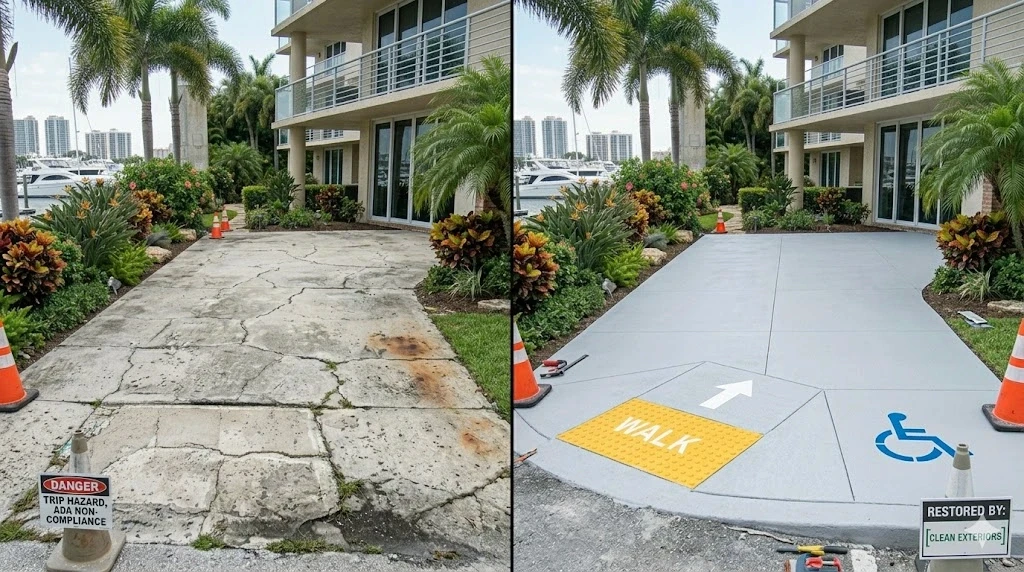
Trip-Free, Code-Compliant Walkways
Sidewalk repair in Fort Lauderdale is both a safety obligation and a liability issue — an uneven, cracked, or heaved sidewalk panel is a trip-and-fall waiting to happen, and in Florida, property owners bear responsibility for walkways on and adjacent to their property. South Florida's aggressive root systems, sandy soil, and intense sun cycling make concrete sidewalk deterioration faster and more unpredictable than in other climates. At Planet Construction FL, we repair sidewalks safely, efficiently, and to ADA compliance standards — eliminating hazards and bringing your walkways back up to code.
Uneven Walks Are Lawsuits in Waiting
Lifted, cracked, or sunken sidewalks are trip hazards, ADA violations, and slip-and-fall lawsuits waiting to happen. For property managers, HOAs, and commercial owners, a damaged walkway is a documented liability the moment someone notices it. And in Florida, root intrusion and soil shifts make the problem progress faster than most expect.
Code-Compliant Walkways, Done Right
We level lifted sections, repair cracks, replace failed slabs, and bring every walk into ADA and local code compliance. Where root intrusion or settlement caused the problem, we address the underlying issue so it doesn't come back. The result is a safe, code-compliant walkway and a documented repair record.
Common Sidewalk Problems in Fort Lauderdale
South Florida's sidewalk deterioration patterns are consistent and recognizable. Tree root infiltration is the most dramatic cause of sidewalk damage in Fort Lauderdale — the area's lush canopy trees produce aggressive surface root systems that lift concrete panels dramatically, creating displacement as severe as three to four inches in a single panel joint. Settlement occurs where soil has been disturbed by irrigation lines, utility installations, or erosion beneath the slab, causing panels to sink and create abrupt edges. Cracking from thermal cycling and shrinkage is universal in aged concrete. In areas with chronic moisture — near irrigation heads, drainage swales, or building downspouts — concrete panels erode and spall progressively. All of these conditions create trip hazards that property owners have a legal obligation to correct.
Trip Hazard Remediation — When Grinding Is Enough
Not every sidewalk elevation difference requires full panel replacement. Where one panel has risen relative to an adjacent panel — typically due to root pressure — the raised edge can often be ground flush with a diamond grinding wheel, eliminating the trip hazard without removing and replacing the concrete. Grinding is faster, less expensive, and less disruptive than panel replacement, and produces a beveled transition between panel heights that meets ADA trip hazard standards (maximum 0.5 inch vertical change). Planet Construction FL evaluates each sidewalk hazard to determine whether grinding is an appropriate solution or whether the underlying cause — root pressure, settlement — makes grinding a temporary fix that will recur. Where roots are the cause and the panel continues to rise, replacement combined with root management is the more lasting solution.
ADA Compliance for Sidewalks & Walkways
ADA compliance for accessible routes — including sidewalks, building approaches, and parking area walkways — is a federal requirement for commercial properties and a standard of care for residential properties accessible to the public. Key ADA requirements for concrete walkways include maximum cross-slope of 2%, maximum running slope of 5% (or 8.33% for ramps with handrails), maximum vertical change at joints of 0.5 inches, and surface must be stable, firm, and slip-resistant. Planet Construction FL's sidewalk repair assessments always include ADA compliance review. Where repairs are needed for safety, we address compliance simultaneously — because a trip hazard repair that doesn't meet ADA standards is an incomplete repair from a liability standpoint.
Our Sidewalk Repair Process
Sidewalk repair begins with a walk-through assessment of the full sidewalk length to map all trip hazards, cracks, settled sections, and compliance deficiencies. Each deficiency is documented and classified by repair method — grinding, slab lifting, panel replacement, or crack repair. For panel replacement, existing concrete is saw-cut at joint lines and removed, the subbase is inspected and repaired as needed, and new concrete is placed and finished to match the adjacent panels in texture. Control joints are saw-cut at proper spacing to prevent future random cracking. For root-caused damage, root pruning or root barriers may be incorporated into the scope to reduce recurrence. Completed repairs are inspected for ADA compliance before project closeout.
Frequently Asked Questions
Who is responsible for sidewalk repair in Fort Lauderdale?
In Fort Lauderdale, the responsibility for sidewalk repair varies depending on whether the sidewalk is within the city right-of-way or on private property. City right-of-way sidewalks are generally the city's responsibility to maintain, but property owners are sometimes responsible for repairs adjacent to their property, particularly where tree roots from private property are the cause. We help property owners understand their specific situation and coordinate with the city where applicable.
How do you fix a sidewalk that keeps being lifted by tree roots?
The most effective long-term solution combines panel replacement with root pruning and root barrier installation at the panel edge. Root barriers redirect future root growth away from the slab, reducing recurrence. In some cases, replacing the concrete panel with a tree grate or permeable surface at the base of the tree is the permanent solution. We evaluate the root situation for each site and recommend the approach with the best long-term outcome.
Can sidewalk panels be replaced to match existing concrete?
New concrete panels will typically appear lighter than weathered adjacent panels immediately after installation — the color difference fades over time as the new concrete weathers. We use consistent aggregate and mix specifications to match the texture and general appearance of existing panels as closely as possible. Color additives can help reduce the visual contrast between new and old panels where aesthetic matching is important.
How long does sidewalk repair take?
Trip hazard grinding takes 1–2 hours per location. Individual panel replacement takes 1 day per panel including demolition, base prep, concrete placement, and finishing. The new concrete requires 3 days before foot traffic and 7 days before vehicle loads. We stage sidewalk repair projects to maintain access to building entrances and accessible routes throughout the project.