Concrete Expansion Joint Repair in Fort Lauderdale
Failed expansion joints let water in and let buildings move where they shouldn't. We rebuild joints with the right sealants and backer for South Florida's climate.
Licensed
4.8-Star Rated
Free Estimates
Joints That Move With Your Building, Not Against It
Expansion joint repair in Fort Lauderdale stops water infiltration before it destroys your building's structural concrete from the inside out. Failed expansion joints are the most common — and most overlooked — pathway for water intrusion in parking garages, concrete decks, and multi-story buildings throughout South Florida. At Planet Construction FL, we replace and rebuild expansion joints using high-performance sealant systems designed to withstand Florida's heat, humidity, and traffic loads — closing the gap between a damaged structure and a protected one.
Failed Joints Let Water and Movement In
Expansion joints exist so your building can move without cracking itself apart. When the sealant fails, water pours in, the joint loses its function, and adjacent concrete starts cracking from stress it was never meant to absorb. Most failed joints look like minor maintenance — until they cause structural damage that costs ten times more to fix.
New Joints That Move and Seal the Right Way
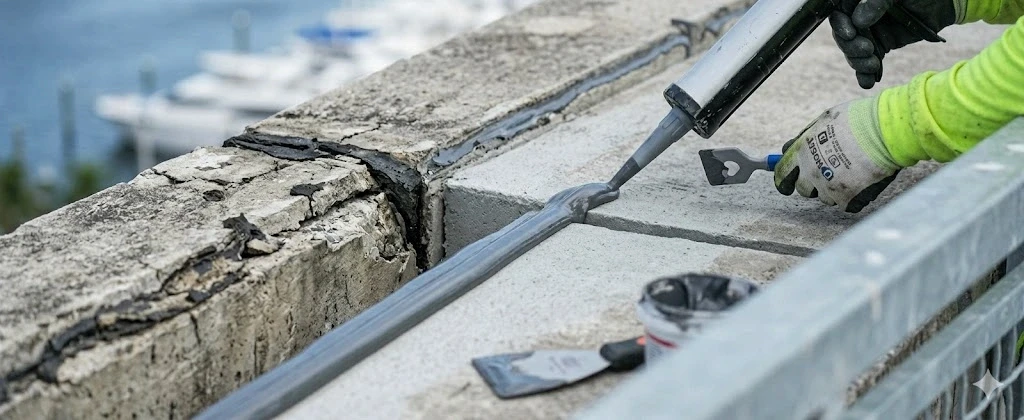
We remove the failed sealant and any damaged adjacent concrete, install proper backer rod, and seal with high-performance sealants matched to the joint's movement and exposure. For larger joints, we use joint systems engineered for traffic, water, and movement. The result is a joint that does its job — moving with the building and keeping water out.
What Are Expansion Joints and Why They Fail
Expansion joints are engineered gaps built into concrete slabs, decks, and walls to accommodate movement caused by thermal expansion, building settlement, and seismic activity. They are intentional breaks in the concrete, filled with flexible sealant materials that allow controlled movement while preventing water, debris, and wind-driven rain from entering the structure. In South Florida's extreme thermal environment — surfaces reaching 180°F in direct sun — these joints work hard every day. Over time, sealants harden, crack, debond from joint faces, or are torn away by foot and vehicle traffic. Once a joint fails, it becomes a direct water entry channel to the concrete below.
Signs of Expansion Joint Failure
Failed expansion joints are often visible even without close inspection. Look for cracked, shrunken, or missing sealant material — sections of open gap with no flexible fill. Dark staining around joint edges indicates water has been infiltrating for some time. Rust staining below joints on soffits or columns is a serious sign that water is reaching the rebar layer in the slab above. Spalling concrete along joint edges means freeze-thaw (rare in Florida) or chemical damage from infiltrating water has already begun attacking the concrete on either side of the joint. In parking garages, oil staining alongside joint deterioration indicates vehicle traffic is also tearing at the sealant material.
Types of Expansion Joint Repairs
Expansion joint repair options range from sealant replacement on sound joints to full joint rebuild on damaged or modified joints. Simple sealant replacement involves routing out old sealant to the full joint depth, cleaning the joint faces, and installing new backer rod and sealant — restoring the joint to full performance. Where joint faces are spalled or cracked, the concrete at the joint edges must be repaired and properly profiled before new sealant can adhere. In high-movement or vehicular applications, preformed compression seals or armor joint systems may be specified to provide greater durability than field-applied sealants alone. We select the repair method appropriate to each joint's movement requirements and traffic exposure.
Parking Garage Expansion Joints — Special Considerations
Parking garages have the most demanding expansion joint conditions of any building type. Vehicular traffic creates dynamic loading that tears at joint sealants. Fuel and oil exposure chemically degrade many sealant materials. The combination of heavy loads, chemical exposure, and South Florida's UV heat requires joint systems specifically engineered for parking structure applications. Planet Construction FL uses DOT-approved polyurethane and modified silicone sealants in parking applications — materials with proven resistance to vehicle traffic, fuel, and UV degradation. In multi-level parking structures, we also coordinate joint repairs with the deck waterproofing system to ensure the joints don't become the weak point in an otherwise complete waterproofing envelope.
Our Expansion Joint Repair Process
Every expansion joint repair begins with joint mapping — documenting the location, condition, dimensions, and movement characteristics of every joint in the scope. Old sealant is mechanically routed to the full joint depth to ensure proper adhesion of new material. Joint faces are ground clean and free of contamination. Backer rod is installed to the correct depth to control sealant profile and prevent three-sided adhesion — which causes premature sealant failure. Primer is applied where specified by the sealant manufacturer. Sealant is gun-applied in a single continuous pass, tooled to a concave profile, and allowed to cure without traffic exposure. We inspect the completed joint for voids, adhesion failure, and proper profile before the area is returned to service.
Frequently Asked Questions
How often should expansion joints be replaced?
Field-applied polyurethane sealants in parking and deck applications typically last 5–10 years before resealing is needed, depending on traffic volume and UV exposure. Silicone sealants in sheltered applications may last longer. Regular annual inspections catch joint failures before water infiltration causes downstream concrete damage — which is always far more expensive to repair than the joint itself.
Can expansion joint repair stop existing water leaks?
Yes — if the joint is the source. We confirm the source of leaks through water testing and visual tracing before specifying repairs. In many cases, repairing failed expansion joints eliminates interior water infiltration that building owners have been managing for years without addressing the actual cause.
Do expansion joint repairs require permits?
Standard sealant replacement on maintenance-level joint repairs typically does not require a permit. Structural joint modification, armor joint installation, or joint repairs conducted as part of a broader structural restoration or waterproofing project may require permits. We assess permit requirements for each project as part of our initial review.
What is the difference between an expansion joint and a control joint?
A control joint (also called a construction joint or saw-cut joint) is designed to manage where shrinkage cracking occurs in a concrete slab — it does not accommodate significant movement. An expansion joint is specifically engineered to allow thermal movement between two separate concrete sections. They require different repair approaches — and using the wrong repair material on either type creates problems down the line.