Post-Tension Cable Repair in Fort Lauderdale, FL
Failed PT cables can quietly compromise an entire slab. We locate, expose, and repair tensioned cables with the precision this work demands — and full documentation.
Licensed
4.8-Star Rated
Free Estimates
Precision Repairs for Tensioned Slabs
Post-tension cable repair in Fort Lauderdale is among the most specialized structural repair services available — and one where the stakes of getting it wrong are extremely high. Post-tensioned concrete slabs are common throughout South Florida's residential and commercial buildings, and when a tendon fails, the consequences for slab performance and structural integrity can be significant. At Planet Construction FL, we work with licensed structural engineers to identify, assess, and repair post-tension failures in Fort Lauderdale's buildings — safely, correctly, and with full documentation.
A Failed PT Cable Compromises the Whole Slab
Post-tension cables are the hidden tensioned steel that holds many modern slabs together. When one fails — from corrosion, water intrusion, or impact — the slab silently loses structural capacity in a way that visual inspection alone can't catch. Working on PT slabs without the right knowledge and equipment is dangerous; ignoring the problem is worse.
Specialized PT Repairs With Full Documentation
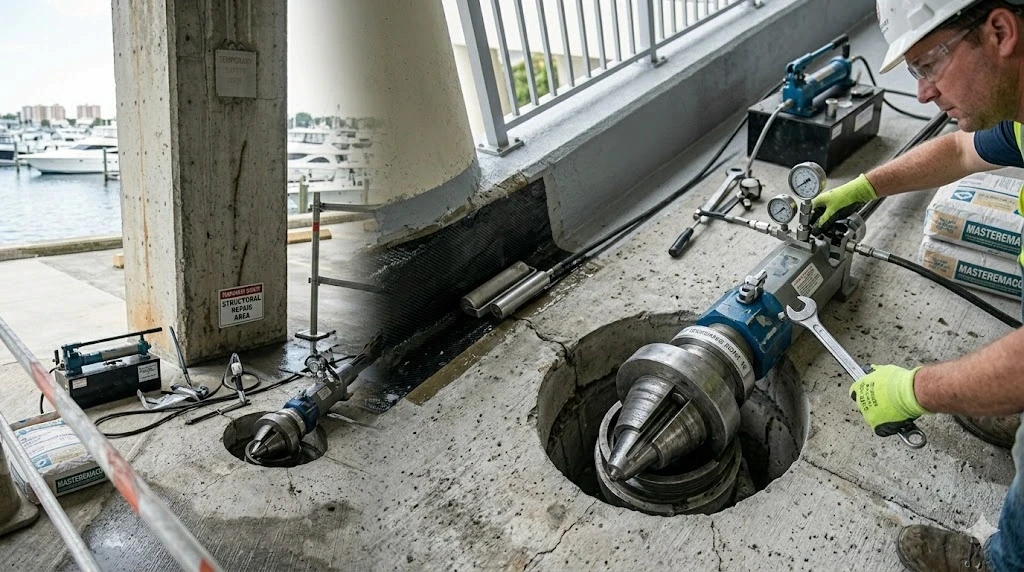
We work with the precision PT repair demands: locating the cable accurately, exposing it carefully, repairing or replacing the affected section under proper tension, and rebuilding the slab to spec. Every repair is photographed, measured, and documented for the engineer of record, so you have full records of the work performed.
What Are Post-Tension Cables and Why They Fail
Post-tensioned concrete slabs are reinforced with high-strength steel tendons — cables or strands — that are tensioned after the concrete has cured. This tensioning places the slab in compression, dramatically increasing its load capacity and allowing thinner, longer-span slabs than conventional rebar reinforcement allows. In South Florida, post-tensioned slabs are common in condominium buildings, parking garages, and residential construction built from the 1970s onward. Tendon failure occurs when corrosion attacks the high-strength steel wire — which is far more susceptible to stress corrosion than conventional rebar — or when mechanical damage severs a tendon during construction or renovation. Salt air, moisture infiltration, and construction damage are the primary failure causes in Fort Lauderdale's buildings.
Signs of Post-Tension Cable Failure
Post-tension tendon failures produce specific, recognizable indicators. A loud report — often described as a gunshot sound — heard within the building is sometimes the first sign of a tendon failure as the severed, high-energy strand releases its stored tension. Cracking that follows the tendon layout grid — running in straight lines across the slab in both directions — indicates loss of compression in the slab from one or more failed tendons. Visible corrosion staining at the slab soffit along tendon lines, combined with spalling along those lines, is a clear visual indicator of tendon corrosion. Tendon end anchor blowouts — where the concrete around the tendon pocket at the slab edge fails — are another indicator. Any of these signs requires immediate professional assessment, not observation and waiting.
Why Specialized Repair Is Critical
Post-tensioned slabs are under active, high-energy compression — the steel tendons contain enormous stored energy. Disturbing the slab or tendons without understanding the tendon layout and current tension state is dangerous. Cutting through a post-tensioned slab for plumbing or mechanical penetrations without identifying and protecting the tendons can sever live tendons, releasing energy suddenly and catastrophically. Planet Construction FL strictly follows established protocols for working in and around post-tensioned slabs: tendon identification using ground-penetrating radar or existing structural drawings before any cutting or coring, coordination with the structural engineer of record, and repair execution that follows the approved repair design. No shortcuts are acceptable on PT slab repair.
Our Post-Tension Repair Process
Post-tension tendon repair begins with a structural assessment coordinated with a licensed structural engineer. The failed tendon location is identified and the extent of corrosion or damage is mapped. The repair design — developed by the engineer — specifies the repair method: in most cases, the failed tendon is cut beyond the corrosion zone, a new coupler and supplemental tendon segment are installed, and the tendon is re-stressed to restore the original design tension level. The concrete at the repair zone is then rebuilt with FDOT-approved repair mortar, and the anchor pocket is restored. Throughout the process, the slab is monitored for any additional tendon failures triggered by changes in the compression state, and the structural engineer approves each phase before work proceeds.
Frequently Asked Questions
Is it safe to occupy a building with a failed post-tension tendon?
It depends on the number of failed tendons, their location, and the slab's overall structural condition. A single isolated tendon failure in a slab with significant redundancy may not create an immediate life safety risk, but requires prompt engineering assessment. Multiple failures, failures at critical slab locations, or failures combined with existing slab distress may require immediate load restrictions or area closures. This determination must be made by a licensed structural engineer — not assumed to be safe.
How do you identify post-tension tendons before cutting or coring?
Ground-penetrating radar (GPR) scanning is the most reliable non-destructive method for locating post-tension tendons in a concrete slab before cutting. GPR produces a scan of the tendon layout that allows penetrations to be located between tendons rather than through them. Planet Construction FL coordinates GPR scanning for any project involving cuts or penetrations in a suspected post-tensioned slab — it is non-negotiable on these projects.
Can all post-tension tendon failures be repaired?
Most post-tension tendon failures can be repaired with the coupler and re-stressing approach described above, provided the corrosion or damage is localized rather than distributed along the tendon's full length. Tendons with widespread corrosion that extends through multiple bays may require a different structural solution — supplemental conventional reinforcement or CFRP strengthening — rather than individual tendon replacement. The structural engineer assesses each failure and specifies the appropriate repair or strengthening approach.
Does post-tension cable repair require a permit?
Yes — post-tension structural repair is a permitted structural repair requiring engineering drawings and calculations for permit submission. Planet Construction FL manages the full permit process and works with the structural engineer to prepare the documentation required for building department review and approval.