Retaining Wall Repair in Fort Lauderdale, FL
A failing retaining wall doesn't just lean — it threatens everything behind it. We diagnose the cause, reinforce the structure, and restore drainage for a lasting fix.
Licensed
4.8-Star Rated
Free Estimates
Reinforce, Drain, and Protect — In One Job
Retaining wall repair in Fort Lauderdale addresses one of the most structurally consequential failures on residential and commercial properties — a retaining wall that is leaning, cracking, or separating is actively failing under the lateral earth pressure it was designed to resist. In South Florida's sandy, water-saturated soil conditions, retaining wall failures can be sudden and cause significant property damage. At Planet Construction FL, we assess retaining wall conditions accurately, address the drainage issues that are almost always the root cause, and restore or replace walls to proper structural performance.
A Leaning Wall Threatens Everything Behind It
A leaning, cracked, or bulging retaining wall isn't just a wall problem — it's a slope, drainage, and soil pressure problem all at once. Patching the visible damage without solving the underlying cause guarantees the wall will move again, usually faster the second time. And when a retaining wall finally fails, it takes everything behind it with it.
Drainage, Reinforcement, and Restoration in One Job
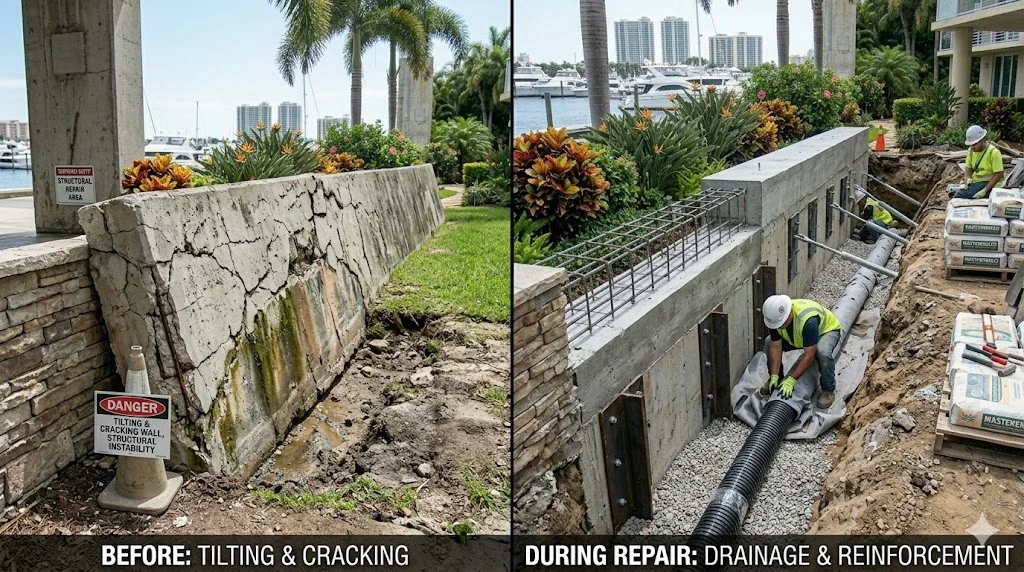
We start by addressing what's actually moving the wall — drainage problems, soil pressure, or structural failure — and then we reinforce, repair, or rebuild the wall using materials and methods matched to the situation. Proper drainage gets installed behind the wall so water never has a chance to push it out again. The repair holds because the cause is solved.
Signs of Retaining Wall Failure
Retaining wall problems are often visible well before catastrophic failure occurs — if you know the warning signs. Horizontal cracking across the wall face indicates bending stress from lateral earth and hydrostatic pressure that is approaching or exceeding the wall's capacity. Forward leaning or tilting — even a few inches of outward movement at the top — is a serious sign that the wall's structural resistance has been overcome by the forces behind it. Vertical cracking at the wall's ends indicates differential settlement or movement at the foundation. Bulging of the wall face in the middle of a span indicates soil pressure concentrated in that zone. Separation at the footing-to-wall joint, wet staining throughout the wall face, or water weeping through the wall are signs that drainage is failing and hydrostatic pressure is building — the most common cause of retaining wall failure in South Florida.
Why Drainage Is Always the Root Cause
Most retaining wall failures in Fort Lauderdale are ultimately drainage failures. A properly drained retaining wall resists only the lateral pressure of the soil — a predictable, manageable load. A poorly drained wall also resists hydrostatic water pressure from saturated soil — a load that can be 50% or more greater than the dry soil pressure alone, and one that increases with every rain event. South Florida's intense rainfall saturates soil rapidly and repeatedly throughout the year, making drainage detail the most critical element of any retaining wall design or repair. Planet Construction FL always addresses drainage as part of every retaining wall repair scope — installing weep holes, French drains, or gravel drainage columns behind the wall as appropriate to the specific condition. Repairing the wall without fixing the drainage is a temporary solution.
Retaining Wall Repair Methods
The repair approach depends on the wall type, extent of damage, and the cause of distress. For concrete block retaining walls with cracking and minor movement, crack repair with epoxy injection combined with drainage correction and surface waterproofing can restore performance. For walls that have exceeded their structural capacity — significant leaning, widespread cracking, or foundation undermining — partial or full replacement with a properly designed and drained replacement wall is the correct solution. Carbon fiber strap systems can be used to resist ongoing lateral pressure in walls that cannot be excavated for conventional repair, bonding horizontal straps to the wall face and anchoring them to deadman anchors in the undisturbed soil behind the wall. We evaluate each wall's condition and specify the repair approach that provides the most durable, cost-effective result.
Our Retaining Wall Repair Process
Every retaining wall repair engagement begins with a structural condition assessment — documenting crack locations, measuring wall deflection, evaluating foundation condition, and assessing the drainage system (or lack thereof) behind the wall. A written scope of work follows, detailing the repair approach, drainage solution, and any permit requirements. For most structural retaining wall repairs, a building permit is required in Fort Lauderdale and Broward County. After permit issuance, repair work proceeds according to the scope — from crack repair and carbon fiber strapping on lightly distressed walls, to full excavation, demolition, and replacement on severely compromised structures. Drainage improvements are always the final step, ensuring the repaired wall won't face the same conditions that caused the original failure.
Frequently Asked Questions
Is a leaning retaining wall an emergency?
Yes — any retaining wall showing forward movement should be assessed by a professional immediately. A wall that is actively leaning is failing under load, and progressive failure can accelerate suddenly, particularly during or after heavy rain when soil saturation dramatically increases lateral pressure. Restrict access to the area near a leaning wall and schedule a professional assessment without delay.
Do I need a permit to repair a retaining wall in Fort Lauderdale?
Retaining walls over a certain height — typically 30 inches — require a building permit for construction or structural repair in Fort Lauderdale and Broward County. Permit requirements include structural engineering drawings for walls above this threshold. Planet Construction FL manages the permit process and coordinates with structural engineers where engineering documentation is required.
What is the best material for retaining walls in South Florida?
Poured concrete and concrete masonry unit (CMU) block are the most common and durable retaining wall materials in South Florida. Properly designed and drained, both perform well in Fort Lauderdale's conditions. Timber retaining walls have a shorter service life in South Florida's heat and humidity and are generally not recommended for permanent applications. Segmental retaining wall systems (interlocking concrete block) are effective for walls under four feet in height with proper drainage behind the wall.
How long does retaining wall repair take?
Crack repair and drainage correction on a stable wall can often be completed in 2–4 days. Partial wall replacement — removing and rebuilding a failed section — typically takes 5–10 days including excavation, forming, concrete placement, and backfill. Full wall replacement on larger structures is scoped individually after the assessment and may take 2–4 weeks depending on wall length and height.