Parking Lot Concrete Repair in Fort Lauderdale, FL
Cracked, sunken, and faded lots cost you tenants, customers, and liability claims. We repair, resurface, and re-stripe parking lots to look — and perform — like new.
Licensed
4.8-Star Rated
Free Estimates
Safer Lots, Cleaner Lines, Happier Tenants
Parking lot repair in Fort Lauderdale is a commercial necessity — a deteriorating parking lot creates safety hazards for customers and employees, exposes property owners to slip-and-fall liability, triggers ADA accessibility violations, and delivers a poor first impression that affects every business on the property. South Florida's intense sun, heavy rainfall, and vehicle load cycles accelerate parking lot deterioration significantly. At Planet Construction FL, we repair concrete parking lots comprehensively — addressing structural damage, drainage failures, ADA compliance, and surface restoration in a single coordinated project.
A Bad Lot Is the First Thing Visitors See
A cracked, faded, pothole-ridden parking lot is the first impression every visitor gets. It also creates trip hazards, drainage issues, ADA compliance problems, and the kind of ongoing liability that property managers lose sleep over. Patch jobs only work for so long before the underlying base and surface need real attention.
Lots That Look Clean, Drain Right, and Stay Compliant
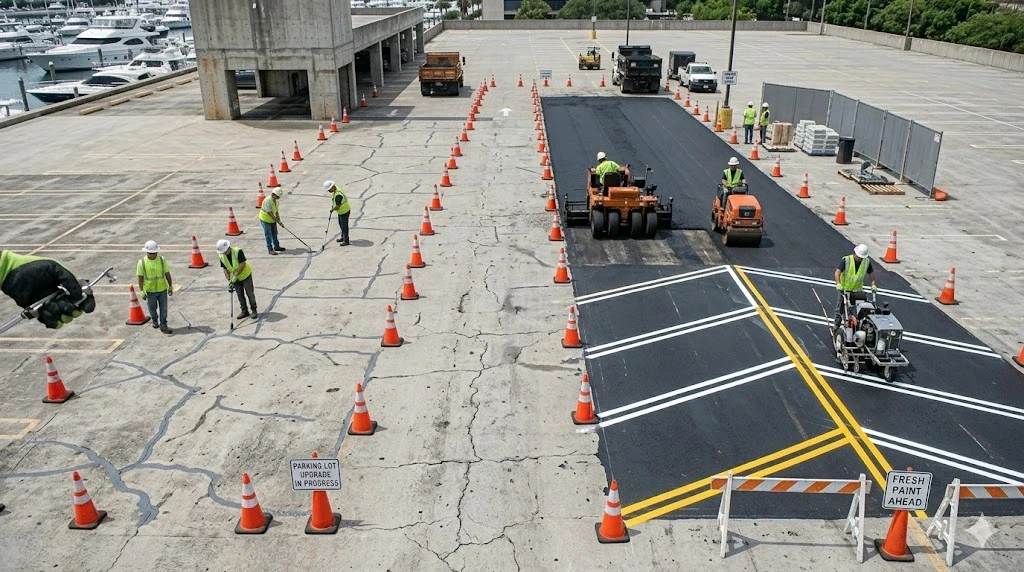
We repair structural damage, level sunken sections, fill cracks with the right sealants, and resurface or recoat where needed — then re-stripe and refresh ADA markings to current code. The result is a lot that drains properly, looks clean, and protects you from liability. We sequence work to minimize disruption to tenants and customers.
Common Parking Lot Problems in Fort Lauderdale
Concrete parking lots in Fort Lauderdale face a specific combination of deterioration drivers. UV radiation breaks down the concrete surface, producing a porous finish that absorbs water and staining more aggressively than new concrete. Joint failure between concrete panels allows water to undermine the base course — leading to panel settlement, cracking, and edge deterioration. Vehicle loading cycles over years create fatigue cracking, particularly at joint edges and in areas with subgrade inconsistency. Oil and fuel spills chemically degrade the concrete surface. Drainage design failures cause chronic ponding that accelerates surface erosion and joint deterioration. ADA-compliant features — accessible stalls, ramps, and pathways — deteriorate with the rest of the lot and may fall out of compliance over time.
Repair vs. Full Replacement — How We Evaluate
Full parking lot replacement is expensive and disruptive. In many cases, targeted concrete repair — combined with joint restoration, drainage correction, and a protective coating — restores the parking lot to serviceable condition for a fraction of replacement cost. Planet Construction FL evaluates parking lot condition based on structural integrity of the concrete panels, degree of joint deterioration, extent of base course compromise from water infiltration, and ADA compliance status. Panels with significant cracking and differential settlement may require replacement; panels with surface distress and joint failures are typically repairable. We provide an honest assessment and a recommendation that serves the property owner's long-term interest, not our project revenue.
Our Parking Lot Repair Services
Planet Construction FL's parking lot repair scope covers the full range of concrete parking lot deficiencies. Crack repair — routing and sealing moving cracks, epoxy injection of dormant structural cracks. Joint restoration — replacing failed expansion joint sealants throughout the lot. Panel replacement — full-depth concrete panel replacement for panels with irreparable structural damage. Slab lifting — raising settled panels with polyurethane foam injection. Edge repair — rebuilding deteriorated panel edges at joint locations. Drainage improvements — additional drain inlets, inlet enlargement, re-grading of ponding areas. ADA compliance repair — resurfacing accessible stalls to proper slope, rebuilding ramps, repairing accessible pathways and curb cuts. Traffic marking — complete restriping after surface work is complete.
ADA Compliance in Fort Lauderdale Parking Lots
ADA compliance for parking lots is a legal obligation — not an optional upgrade. Fort Lauderdale commercial properties are required to provide accessible parking spaces in the correct quantity and dimensions, accessible routes from parking to building entrances, and compliant curb cuts and ramps throughout the accessible path of travel. Concrete surface settlement, cracking, and deterioration frequently push these features out of compliance — accessible stall slopes exceeding 2%, trip hazards on accessible routes, and damaged curb ramps are common findings. Planet Construction FL's parking lot repair scopes always include ADA compliance review, and we correct identified deficiencies as part of the repair project rather than leaving them for a separate compliance effort.
Frequently Asked Questions
Can parking lot repairs be done while the lot stays open to customers?
Yes — and this is standard practice for commercial properties. We repair parking lots in sections, maintaining access to the majority of the lot throughout the project. Detailed phasing plans are developed before work begins, and temporary traffic control signage is maintained around all active work areas. We coordinate with property owners on section sequencing to minimize impact on high-traffic days and peak business hours.
How long does a parking lot repair project take?
A typical commercial parking lot repair — crack sealing, joint restoration, isolated panel replacement, and restriping — takes 3–7 days depending on the extent of work. Larger lots with multiple panel replacements and drainage improvements may take 2–3 weeks. We provide a detailed project schedule at proposal stage so property owners can plan tenant and customer communications in advance.
How often should parking lot joints be resealed?
In Fort Lauderdale's climate, parking lot expansion joints should be inspected annually and resealed every 4–7 years depending on sealant product type and UV exposure. Joints that have failed completely — gaps with no functioning sealant — should be resealed immediately to prevent base course erosion from water infiltration, which is a far more expensive repair than the joint sealing itself.
What causes parking lot concrete to sink or settle?
Settlement in Fort Lauderdale parking lots most commonly results from erosion of the base course material — sand and aggregate beneath the concrete slab washed away by water infiltrating through failed joints and cracks. Once the support material is gone, the unsupported slab panel sinks under vehicle loads. Polyurethane foam injection fills the void and raises the panel, restoring subgrade support without slab removal.